WenzhouTwelve Watches
中文IllustratedRead

Chapter 01 · Yin03:00–05:00

The Fish Come In Before Daylight

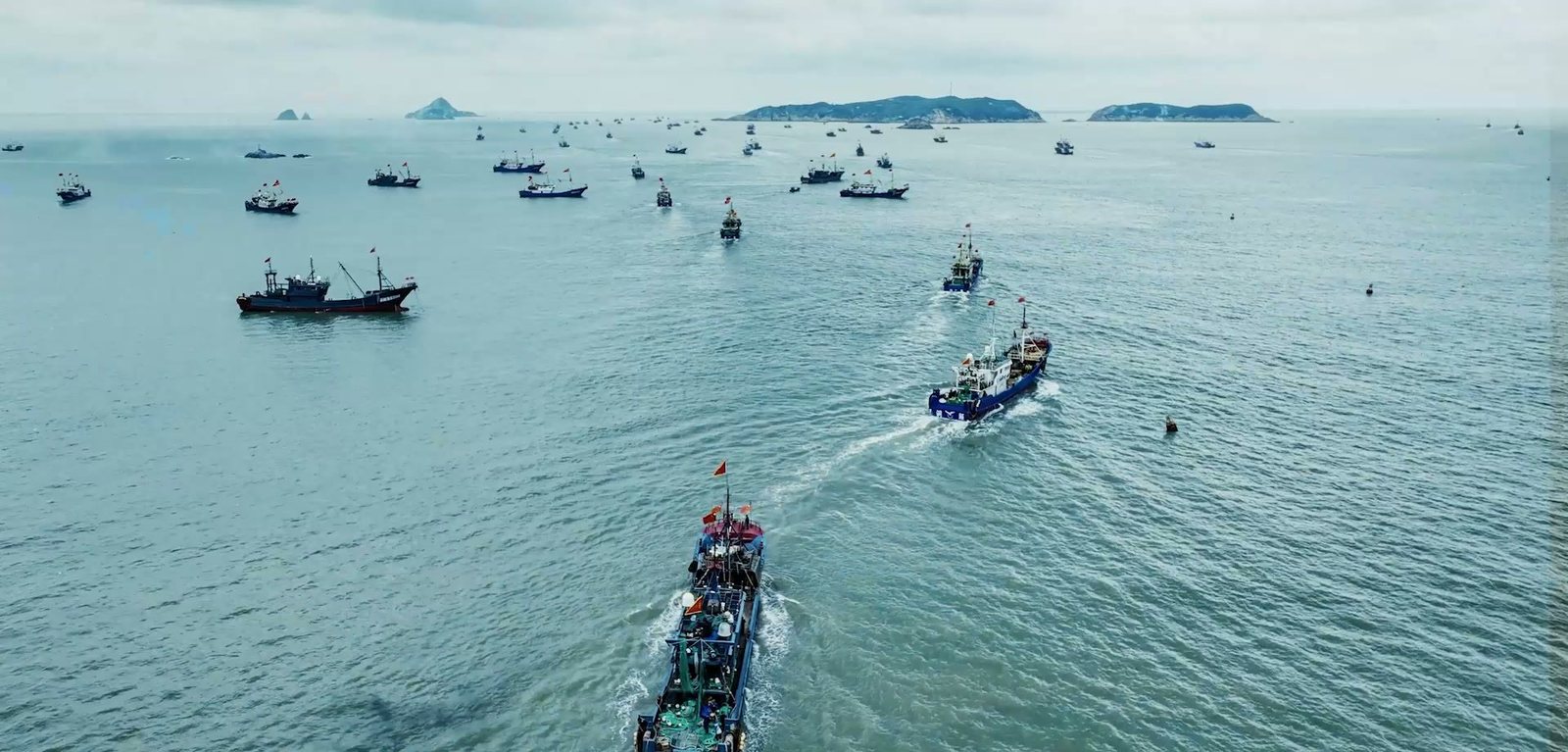
Fishing boats heading out in line as the season opens
Image not loaded

Retry once you are online.

Heading out as the season opensFile photo

At three in the morning the dock lights at Dongsha are still on. The boats are gone.

Freshness starts counting down the second a fish leaves the water. It has to be ashore before daylight.

At Three, the Boats Are Already Out

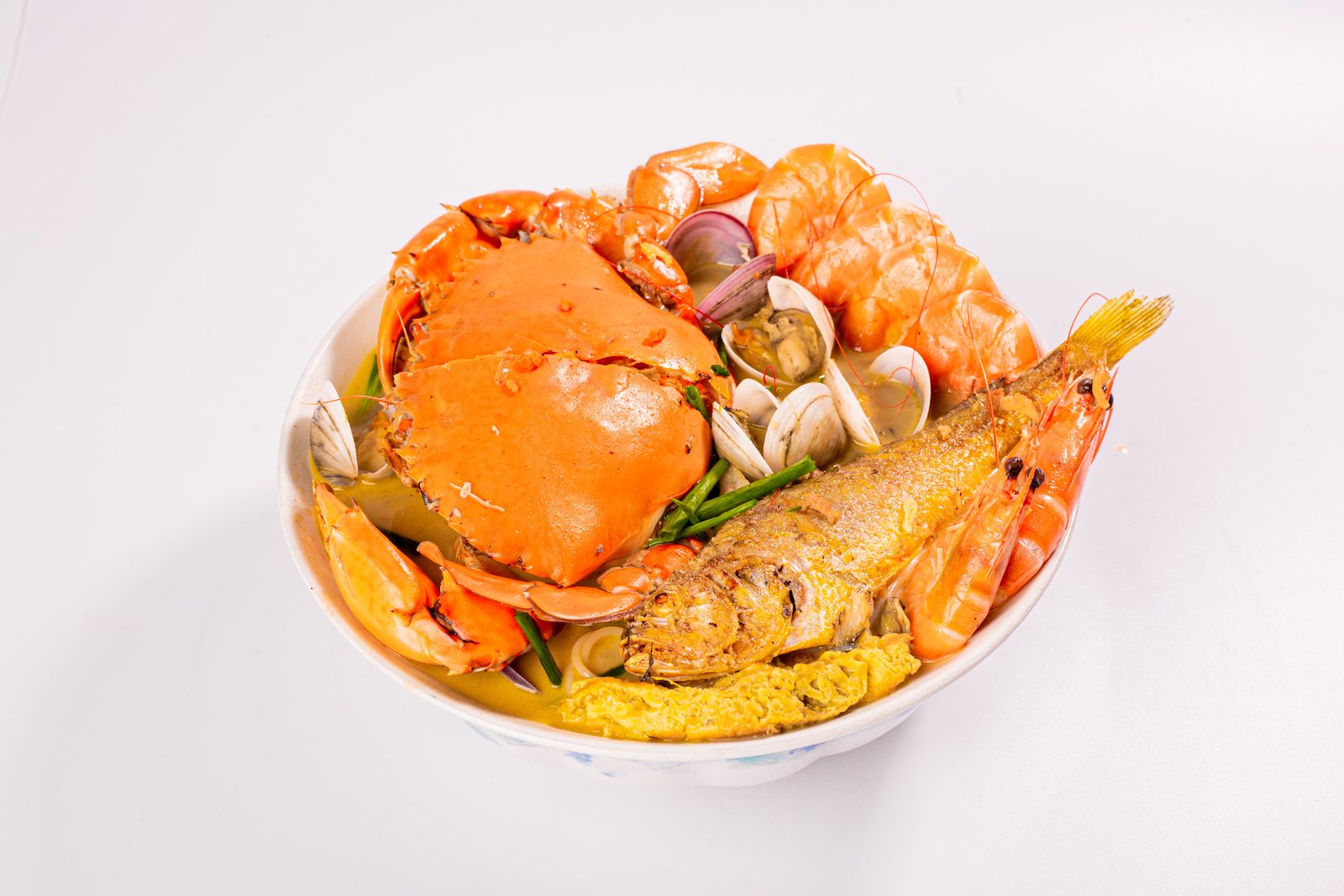
The skipper takes five crew out at three in the morning. By the time they come back before dawn, the hold of the twenty-meter boat is packed with Bombay duck, little yellow croaker, hairtail, swimming crab and pomfret.

A fish goes into iced water the moment it leaves the sea. Six steps stand between the water and the table: the run out, the catch, the run back, the unloading, the sorting, the delivery. The Yin hour is the first of them, and the one fewest people ever see.

The Goods Move While It Is Still Dark

The boats are still out. On shore, the market has already put its lights on.

The nights after the fishing ban lifts are the busiest of the year. The nets go down for a dozen hours, and the first catch races ashore: little yellow croaker shining gold, Bombay duck almost transparent, swimming crabs opening their claws in the baskets. Cold-chain trucks reverse in one after another; the ones carrying only swimming crab form a queue of their own. Frozen stock, which held the market together through the closed season, loses its price in a matter of days.

The mi-iuy croaker carries the strongest sense of season on this line. It floods the market in mid-October and the price falls with it. People who know wait for exactly these few days.
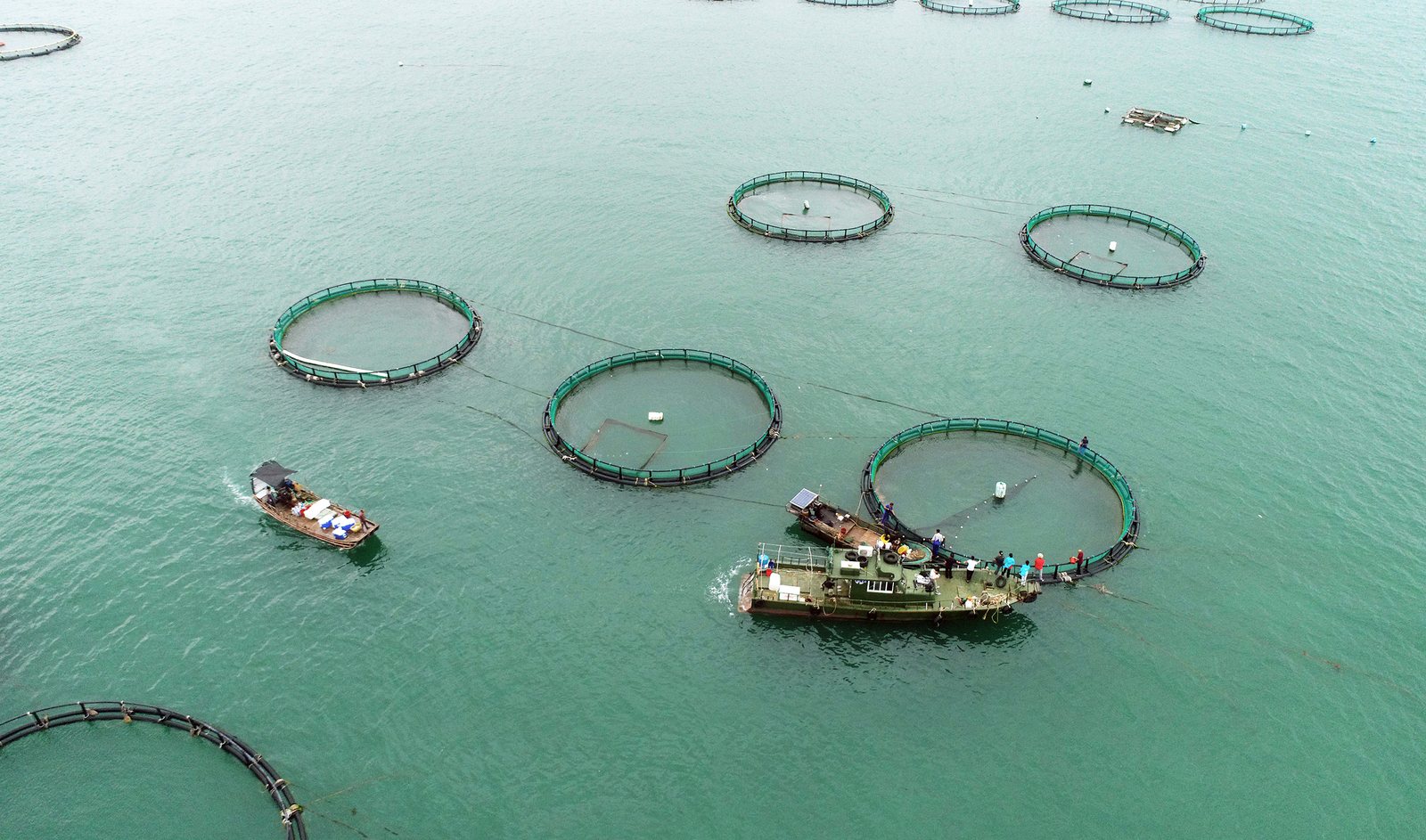
Offshore aquaculture: clusters of circular deep-water cages on green water, two boats alongside
Image not loaded

Retry once you are online.

Offshore farmsFile photo

An Entrance Built Piece by Piece

Most of it changes hands in a single park by the coast.

The seafood wholesale market now sits in the South Yard of the Vegetable Basket park. Its trading shed covers 18,000 square meters, with separate zones for premium seafood, chilled wholesale, shellfish, mud crab and freshwater fish. It moved here wholesale from the North Yard; the new shed is more than five times the size of the old one.

The park was not built in one go. After Jinxiu market closed, more than 200 traders in fresh pork and soy products moved into the Modern Farm Produce Market, merging with the existing vegetable and fruit sellers into a market of over 500 stalls. On Binhai No. 5 Road, the Modern Cold-Chain Frozen Foods Market was Wenzhou's first frozen-food distribution center, packing frozen goods, seafood, delivery and cold storage onto one plot, with a reach that runs down into southern Zhejiang and northern Fujian.

The Shape of a Cold Chain

Nine-tenths of the seafood in a Wenzhou bowl passes through here.

The network rests on the Wenzhou Vegetable Basket Group. Most of the city's wholesale vegetables, meat, poultry and eggs, seafood, soy products, fruit and dairy pass through it. Its work rarely makes the news — it is all weight added to the base plate, one 10,000-tonne cold-chain base at a time.

One chain has to handle both sea and land. Through summer and autumn, Wenzhou's vegetables come mainly from a handful of growing regions in the north.

Temperature is the threshold. From the growing region to the park the chain holds at 0°C. Large yellow croaker stays on ice from the moment it is caught. In the cold store, high-capacity blast freezers drop to −60°C. Some deliveries now go by drone, saving both road time and hands.

In the cold store before dawn, pallets stack to the ceiling: Xinjiang jujubes just in, fresh little yellow croaker, highland greens held in cold sleep, frozen pork and chicken from local farms. What comes into the city in the Yin hour was never only seafood.

The Check You Cannot See

Food coming into the city still has to clear a checkpoint nobody sees.

The seafood market once ran on a rule nobody advertised: thick rope tied around crabs to add weight, later swapped for rubber rope that soaked up more water. That trick was taken apart piece by piece. Today swimming crabs are bound with plastic clips, and the water in a rope no longer counts on the scale.

The Vegetable Basket Group and a group of markets publicly committed to the rules on agricultural product quality and safety, and to heavier spot checks. At the height of the pandemic, drones sprayed disinfectant over the park, each flight lasting close to an hour. "Holding the gate" comes down to what happens in these one or two hours before dawn: the checking, the spraying, the testing.

Before daylight a delivery van pulls out of the park, packed with local seafood, sesame-oil duck, roast goose and dried tofu. The question asked at loading is the same every day: swimming crab, clams, mantis shrimp — all set?

The line has long since stopped ending at home. Wenzhou's large yellow croaker crosses the sea and sells in Italy. The vitality of Wenzhou cuisine, one local restaurant industry figure says, lies in Ou-Yue culture, and the overseas Wenzhou communities scattered across the world are what give it the confidence to travel.

The bid to be named a UNESCO Creative City of Gastronomy runs through this cold-chain base plate. Whether the base is steady shows at the Yin hour.

Five o'clock, and the sky is lightening. The first truck of goods is in the city. The first pot of water is on.

Sources5 items
  • On the night of 3 August 2024 trading peaked at the Wenzhou seafood wholesale market: nearly 60 cold-chain trucks carrying swimming crab, and more than 100 tonnes traded that night. In the 2026 season CCTV's Zhongguo Sannong Baodao filmed on site. (Reports of 5 August 2024 and 21 August 2026)
  • Mi-iuy croaker reaches market in mid-October; in peak season daily volume is about 20 tonnes and the price falls accordingly. (Report of 18 October 2005)
  • In January 2020 the Wenzhou seafood wholesale market moved from the North Yard to the South Yard of the Binhai Vegetable Basket park: an 18,000-square-meter shed, close to five times the old site. "Daily volume above 300 tonnes" was the projection given at the time of the move, not a result. (Reports of 16 and 19 January 2020)
  • In December 2017 Jinxiu market closed. 217 traders across nine lines, including fresh pork and soy products, moved to phase one of the Modern Farm Produce Market, merging with the existing vegetable and fruit business into a market of more than 500 traders. (《锦绣农贸市场19日谢幕 现代冷链物流中心同日开业》, 5 December 2017)
  • The seafood market once used thick rope to add weight to crabs; some traders later switched to rubber rope that absorbed more water. By the time of a March 2018 report, traders had replaced the rope on mud crabs with plastic clips. (《温州市水产批发市场蝤蛑全"松绑"》, 17 March 2018; report of 4 March 2013)
Next watch · 05:00–07:00Mao · Wenzhou Wakes

Chapter 02 · Mao05:00–07:00

Wenzhou Wakes

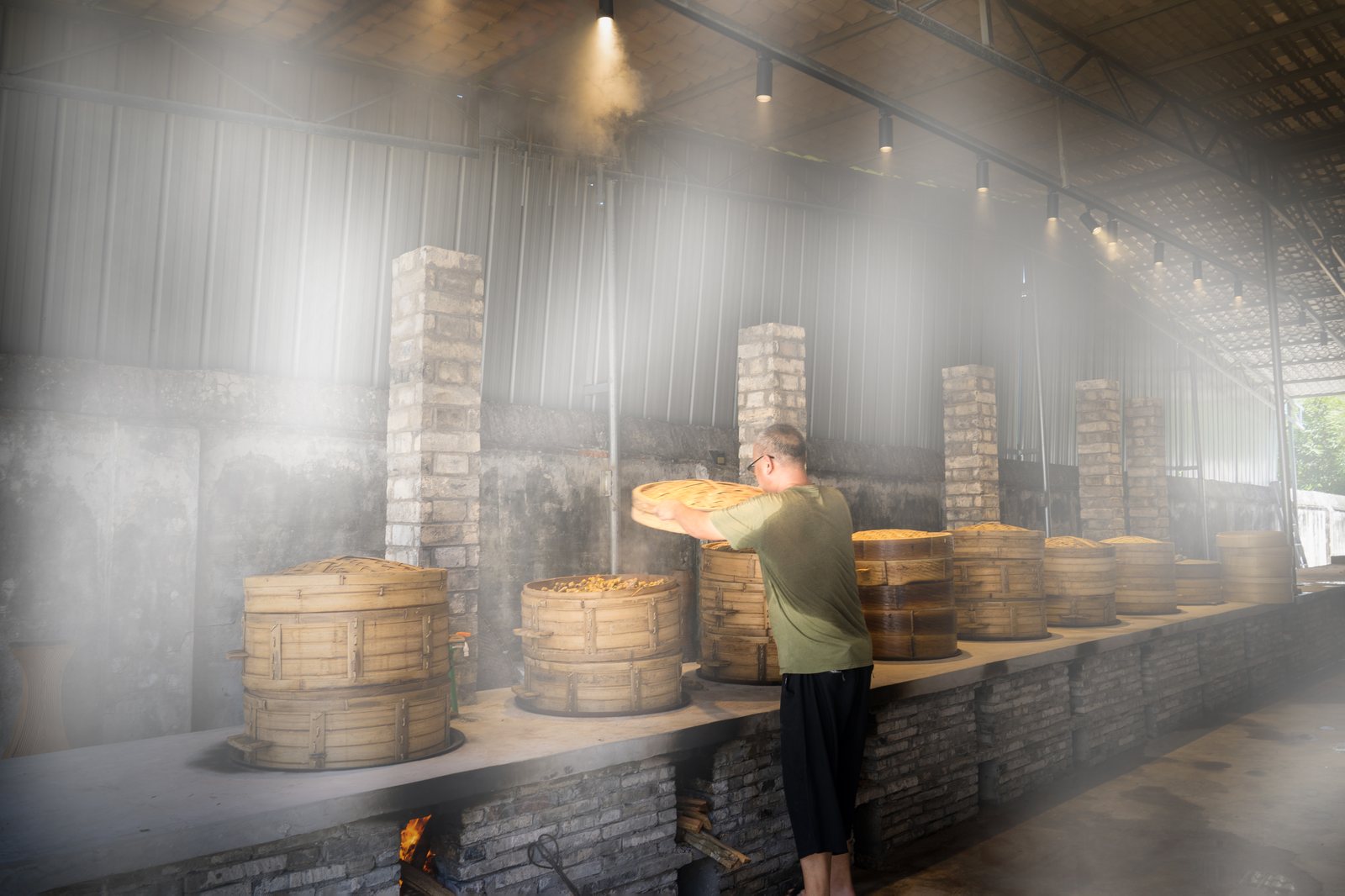
A bamboo steamer lid lifted in a workshop, steam rising
Image not loaded

Retry once you are online.

The first steamer at the stoveFile photo

At five, in a lane of the old town, the first basket of glutinous rice goes onto the stove.

Five O'Clock, the First Basket

Wenzhou people call it *chuifan*. Guizhou's glutinous rice is hot and spicy; the Zhuang five-color version is a patchwork of dyes. Wenzhou's comes in just two kinds, savory and sweet.

There is nothing rare or expensive about it, and it is the meal Wenzhou repeats most. Some have eaten it for thirty years; they move a few streets away and still loop back in the morning for that one taste.

How the rice is made can wait for the Chen hour. This hour belongs to three kinds of people waking up.

The Stallholders

The stallholders wake first.

A family breakfast stall usually runs on three people before sunrise: the father at home steaming basket after basket of mantou and plain buns, the mother at the stall taking money, the son running back and forth between the two. Besides the buns and the rice, the stall sells soy milk and bottled milk.

One document once rewrote what such a stall was. Wenzhou's first industry standard for breakfast required every breakfast kiosk and cart to belong to a licensed supplier, and the one-person pancake and wonton stalls faced being pushed out. For a stallholder, getting up early was never only a matter of stamina.

Wenzhou rice noodles (fen gan) belong to this hour too. In the morning they are usually boiled, the broth clear and the noodles fragrant. A household that cares adds a few pieces of yellow croaker, a few oysters, a pinch of dried shrimp — and the bowl is startlingly fresh before the day has properly started.

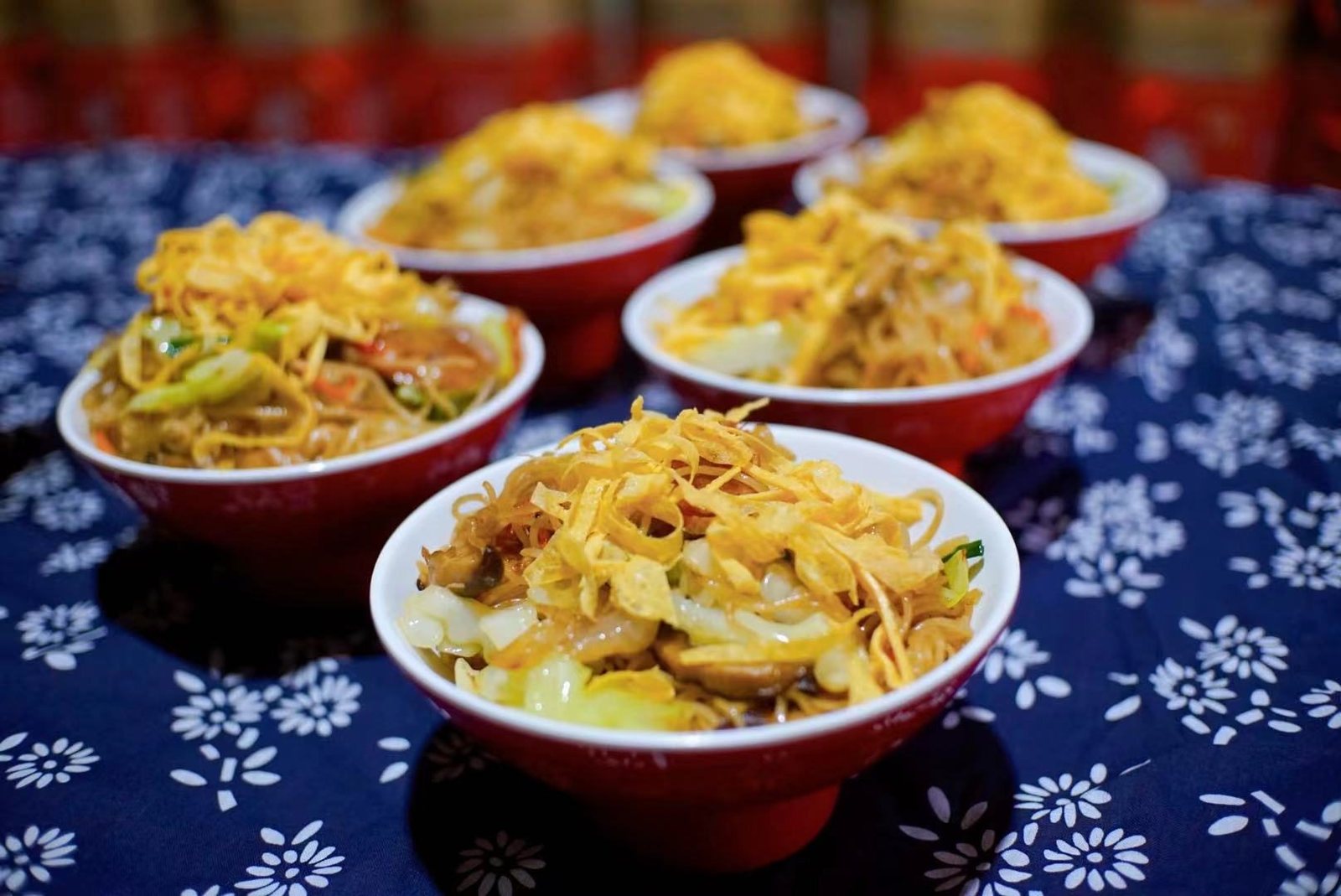
Shacao fried rice noodles in a red bowl with a white rim, topped with shredded omelette, shiitake, greens and dried shrimp
Image not loaded

Retry once you are online.

Fried rice noodlesFile photo

The Old Man

The second way of waking is earlier, and much slower.

An old gentleman gets up a little after five every day and simmers lily bulb, goji, white fungus, Chinese yam, walnut, peanut, oats and cornmeal in one pot. He has not missed a day in more than ten years. Wenzhou knows this kind of medicinal congee well: herbs, grain and seasoning together — take the property of the herb, borrow the taste of the rice, let the food carry the medicine and the medicine strengthen the food.

Not everyone has the patience to watch a pot of congee. The easier route is a bowl of noodles or rice noodles, an egg dropped in, a handful of greens, a glass of milk and a few pieces of fruit.

The old man's five o'clock and the stallholder's five o'clock are the same hour. One waits for the congee to thicken, the other for a customer.

The Old Sign

The third way of waking has been awake the longest.

Jixiangju at the mouth of Wuma Street is a century-old name in southern Zhejiang, selling glutinous rice here since the early 1950s. Locals put it plainly: plenty of Wenzhou kids grew up on its rice.

Morning at an old sign looks like morning anywhere else. One regular comes in every working day, takes a sip of soy milk and a bowl of glutinous rice, and only then does the day start. At weekends she brings the family. She likes to sit facing the lattice window and finish slowly in the old dining room.

The bowl has traveled with the people. Duck tongue, fish balls, glutinous rice — these snacks have gone out across the country with Wenzhou restaurant brands. The city once ran a morning-food program that named Airén songgao, horse-hoof pastry and the "open-mouth laugh" as items to develop.

The same program admitted that Wenzhou breakfast was never a single option. Rice sheets are steamed from a water-milled batter, white enough to see through, lighter and smoother than noodles. Yongjia's Nanxi wheat cakes and Yueqing's Furong wheat cakes each have their own following. Add Wenzhou Rice Noodles (Fen Gan) and Pig Intestine Noodle Soup (Zhu Zang Fen), and claiming a place in a Wenzhou breakfast is not easy.

The Seasons Inside the Rice

The Mao hour wakes more than people. In these two hours, goods from the markets, the docks and the wholesale yards are splitting off towards individual stoves.

Wenzhou has a weakness for glutinous rice: jiuceng gao (nine-layer rice cake), songgao (steamed rice cake), lard cake, one after another. Glutinous dishes follow the calendar too. On the second day of the second month they eat mustard-green rice, said to keep scabies away; on the third of the third month they cook black rice and wish for a full harvest; at New Year they eat eight-treasure rice for luck. The habits are still in Wenzhou homes.

The Mao hour is the plainest of the twelve. No late-night bustle, no banquet display — just a bowl of rice, a bowl of soy milk, and people waking on time.

At seven, the day is bright. Time for *tianguang* — Wenzhou's own word for breakfast — to take the stage.

Sources2 items
  • Wenzhou's first breakfast industry standard, issued in 2008, required breakfast kiosks and carts to belong to a licensed supplier; one-person pancake and wonton stalls were to be phased out. (《首个早餐行业标准出台 个体煎饼摊可能被取缔》, 9 January 2008)
  • The morning-food program listed Airén songgao, horse-hoof pastry and "open-mouth laugh" among the Wenzhou snacks to be developed. (《早安,早餐!》, 30 March 2009)
Next watch · 07:00–09:00Chen · The First Bite of Wenzhou

Image note · Photographs of breakfast stalls and early-morning streets are still to come. The chapter opener shows a workshop steamer and the inline image a market stall; neither is the scene of the events reported.

Chapter 03 · Chen07:00–09:00

The First Bite of Wenzhou

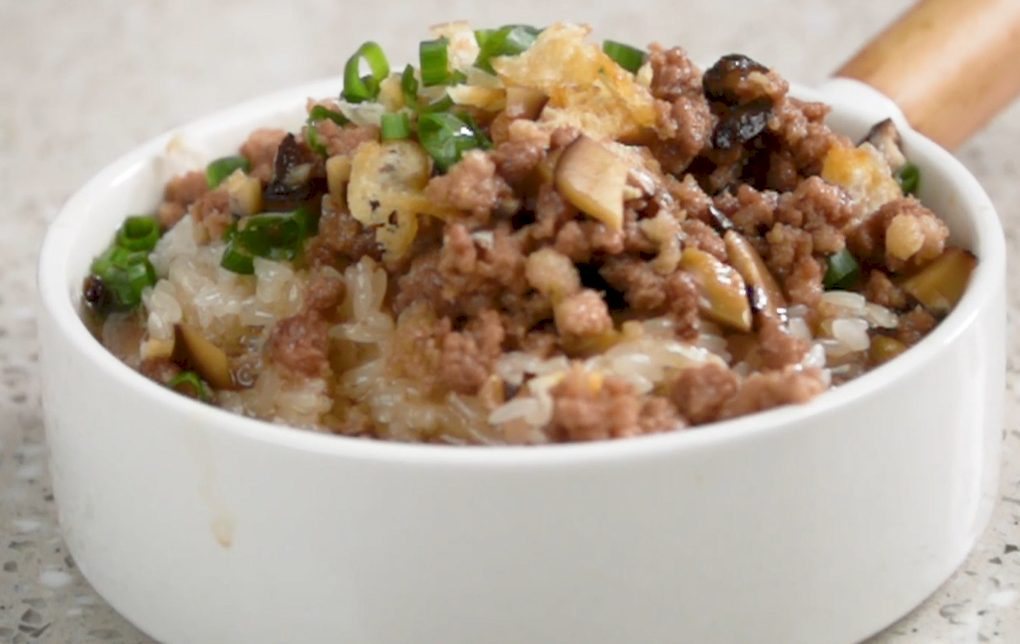
Wenzhou glutinous rice topped with shiitake and minced pork, scattered with spring onion and crackling
Image not loaded

Retry once you are online.

Chuifan, steamed glutinous riceFile photo

In Wenzhou, breakfast has a name of its own: *tianguang*, "daylight". Ask someone what they ate in the morning and they will say they have eaten their daylight — naming a meal after an hour of the day. The older generation has a saying for it: eat your daylight at Bailifangkou.

Bailifangkou sits beside the old Shuomen port. A row of breakfast shops once crowded under the banyan trees there, selling pork-offal noodles, rice congee and glutinous rice in turn. People about to travel ate their fill here and then boarded a boat at the wharf. That daylight was the first meal of the day and the last one before leaving home.

Breakfast is the meal you can least afford to get wrong and the one most likely to repeat. It is ordinary enough for anyone to afford, and serious enough to keep eating for decades.

Savory Rice, Sweet Soy Milk

The name comes from the method: glutinous rice soaked overnight, then set over steam in the morning and cooked slowly. The timing decides the reputation of the bowl — a minute too long and it turns gluey, a minute short and it is hard.

Three steps follow. A spoon of thick sauce simmered from shiitake and minced pork goes over the top; a handful of crushed fried dough sticks goes on; then it is stirred through. The pairing is more or less fixed, and the local paper once summed it up in six characters: savory rice, sweet soy milk.

The combination has been sold on Wenzhou streets for more than a hundred years. Soy milk comes sweet or savory; pour it boiling into raw beaten egg and it becomes egg soy. Anyone in a hurry takes a rice roll instead, sweet or savory, squeezed shut the way you wring a towel — a fat white parcel carried and eaten on the way.

The Heavier Bowl

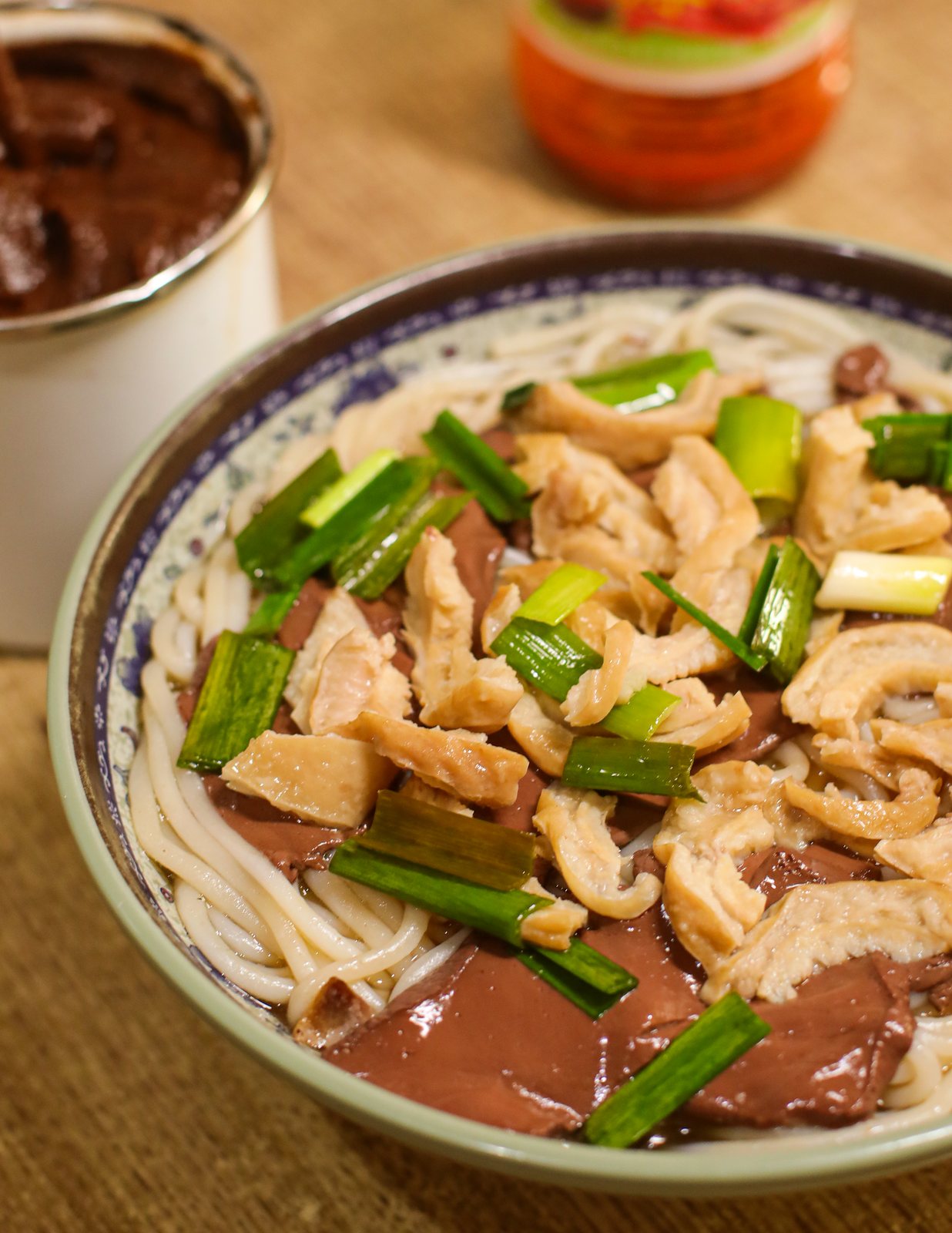
If glutinous rice is the ground color of a Wenzhou breakfast, pork-offal noodles are the accent. Thick rice noodles underneath, pig intestine and duck blood on top, then garlic leaves and bean paste. Heavy, and it goes down smooth.

Among Wenzhou snacks it is young. The most widely told origin story involves a stallholder nicknamed "Spectacles". He lifted the noodles out of the soaking pot and blanched, cut and dressed them to order — and the chop-chop of his knife on the intestine became part of the bowl. Chinese cooking talks about color, aroma and taste, someone said; his pork-offal noodles add a fourth: sound.

Rivals copied the method quickly, and cooking to order became the rule for Wenzhou pork-offal noodles. Rice keeps you steady; the offal bowl keeps you hooked.

A bowl of Wenzhou pork offal rice noodles, topped with pig's blood and intestine, scattered with garlic sprouts
Image not loaded

Retry once you are online.

Pork offal rice noodlesFile photo

The Sisters' Small Hours

Wenzhou breakfast shops are mostly husband-and-wife or family affairs. The Three Sisters rice shop in Fuxue Lane is the one people bring up most.

Chen Aifen, Chen Ailan and Chen Aiping were laid off from their factories one after another. The family had cooked for generations and the three had always fussed over food; they talked it over and opened the shop, and called it Three Sisters. They are all but fussy about ingredients. The eldest puts it plainly: the rice noodles, the oil, the soybeans — every one of them picked out at the market by hand.

Breakfast is a trade that burns time. The sisters close for a few days at New Year and that is all; they are up at three or four to prep, and they work until nearly noon. What they are proudest of is that the rice and the soy milk have not changed in decades. A regular who spent six years abroad came back, ate, and said it tasted exactly the same.

A breakfast shop holds three things: a craft, a standard for ingredients, and a face that remembers how the regulars like it.

Ten Things in a Daylight

Glutinous rice is not the whole of it. Fish balls, fish cakes, duck tongue, dengzhan gao (lamp cake), pork-offal noodles, glutinous rice, potstickers, Wenzhou wontons, Yongjia wheat cake, and fried rice noodles were the ten Wenzhou snacks chosen in an official selection.

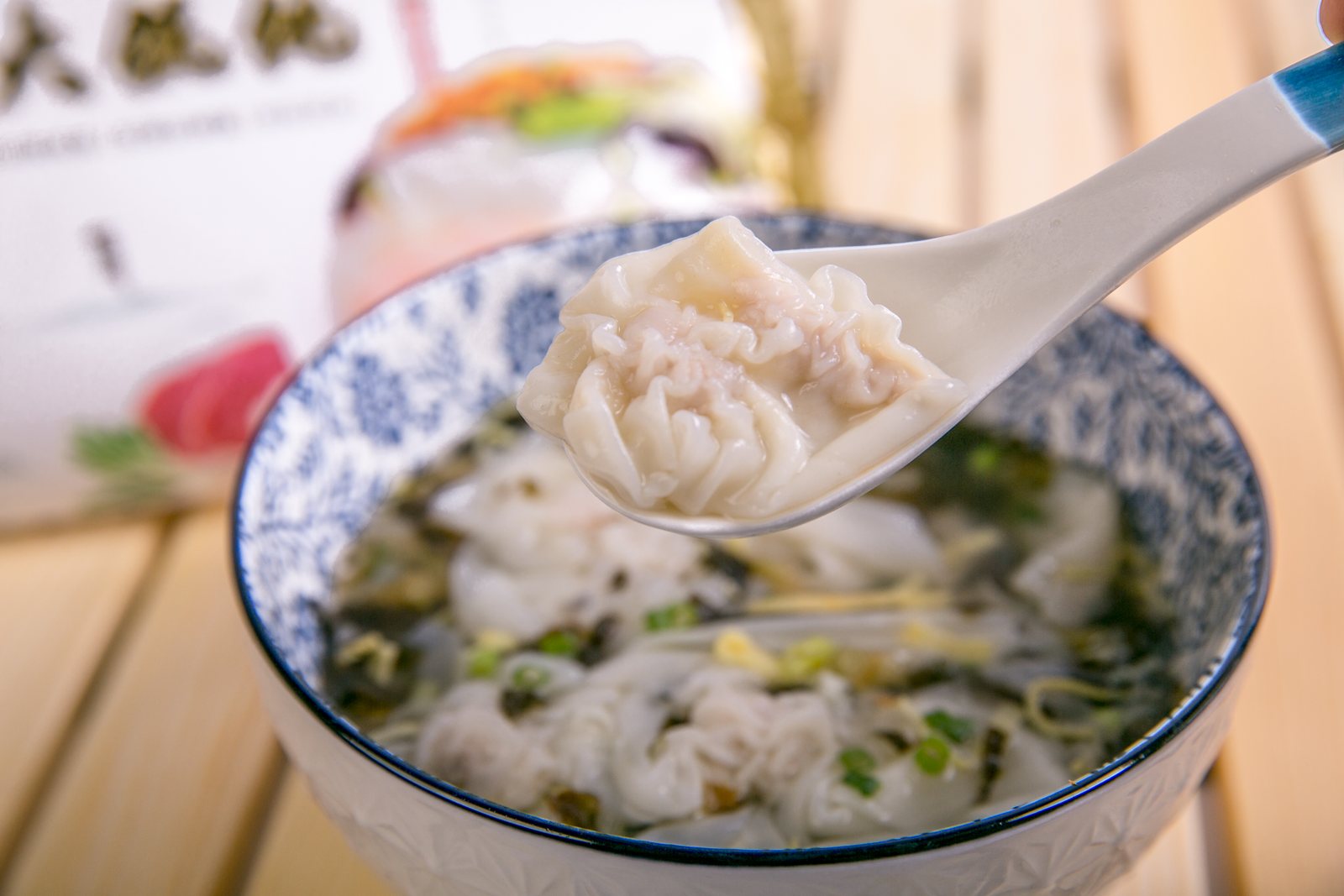
Wenzhou wonton wrappers are thin enough to see through, and each is deliberately left with a gap when folded; in the pot they puff up one by one like small balloons. The filling is fresh pork leg. In the bowl go seaweed, pickled mustard, shredded egg, shiitake, pork floss, and wine-soaked dried shrimp, in a broth that is clear and full of flavor.

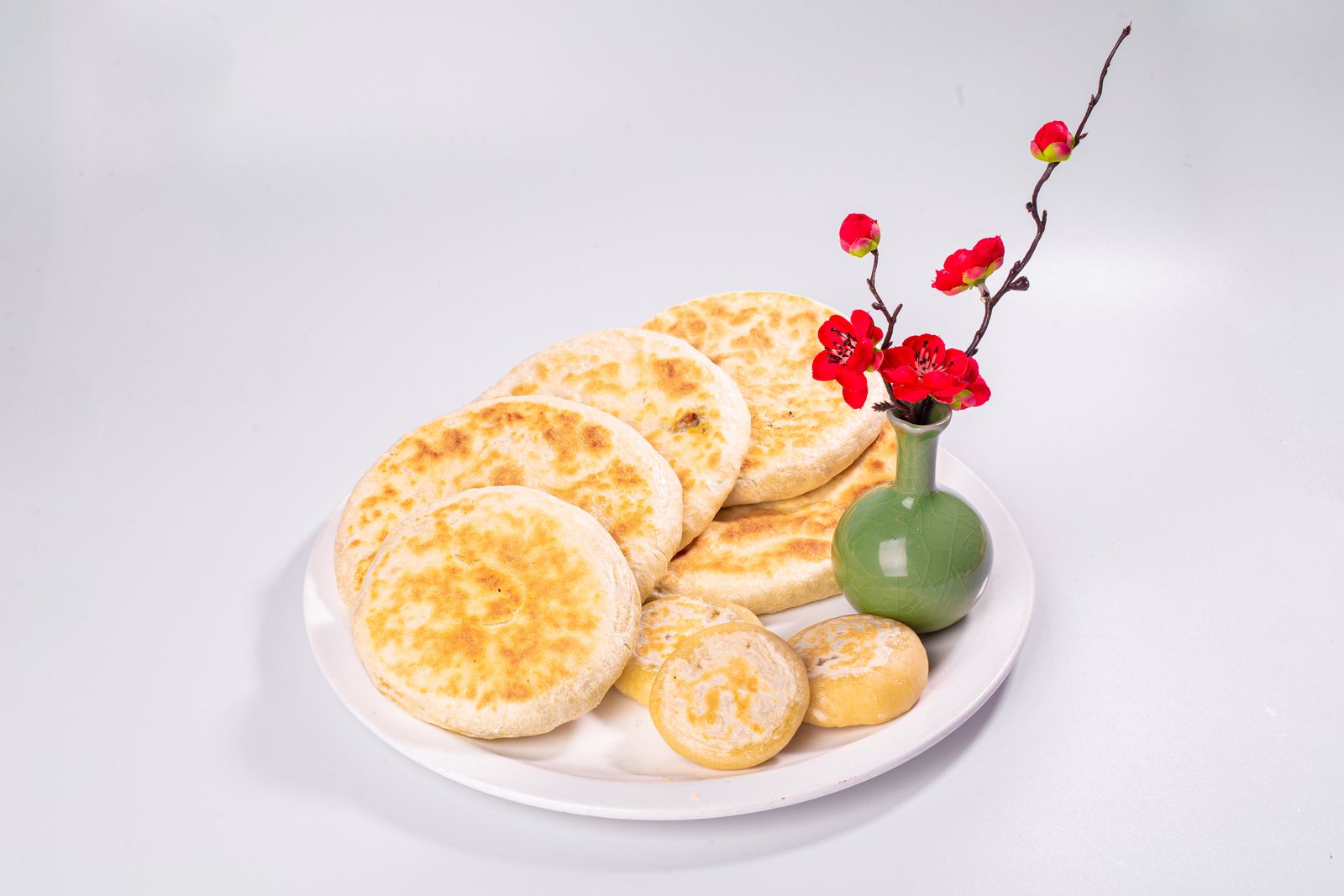
Yongjia wheat cake comes from the sandy fields along the Nanxi River. The land will not hold water, so rice does not grow well, but wheat does — and so this traveling food was born: dried mustard greens and pork belly wrapped inside, griddled golden on both sides, thin skin and plenty of filling.

Fried rice noodles are about *wok hei*, which in Wenzhou dialect is "fragrance from the fire". Soaked noodles go into a hot wok, then shredded pork, egg, dried shrimp and cabbage, one after another; it counts as done only when the pan is hissing. Jiuceng gao is steamed one layer at a time and stacked to the ninth; you eat it by peeling it apart.

Wenzhou wheat cakes: golden rounds with flaky cakes on a white porcelain plate, beside a celadon vase holding a red blossom
Image not loaded

Retry once you are online.

Wheat cakeFile photo

The crafts now have a formal standing. Wenzhou snacks was inscribed onto the municipal intangible cultural heritage list, with nine making techniques named in the annotation — Wenzhou glutinous rice first among them, with Wenzhou big wontons and jiuceng gao also included.

In Wenzhou, glutinous rice runs from breakfast all the way to the banquet. It turns up in snacks, pastries, sweets and main dishes alike, under one name: glutinous foods.

For an authentic daylight, the Wuma–Mochi historic district in the old town is the densest. Chan Street, Wuma Street and Gongyuan Road run east–west; Jiefang Street cuts north–south; 1.4 kilometers of frontage string together fourteen back lanes, with snack shops and Wenzhou cuisine restaurants packed onto the same street. At the other end are Bailifang and Shuomen — the place in the old saying, still the stretch where old-town breakfast shops cluster.

Wenzhou people do not think any of this is remarkable. They go out on time each day, eat a bowl of rice, drink a cup of soy milk, and go their separate ways.

At nine the breakfast shops quiet down and the markets and docks take over. Where all of it comes from is the next chapter's business.

Sources6 items
  • "Eat your daylight at Bailifangkou" is a local saying, referring to the breakfast shops that gathered under the banyan trees at Bailifangkou near the old Shuomen port in the 1970s and 1980s, selling pork-offal noodles, rice congee and glutinous rice. (《一碗糯米饭,滋养百味人生》, 23 July 2024)
  • Rice with soy milk appeared on Wenzhou streets by the late Qing and early Republic; by the early 1950s the pastry shop of Jixiangju, a century-old name at the mouth of Wuma Street, made rice and soy milk its breakfast staples. (Reports of 27 June and 23 July 2024)
  • Pork-offal noodles became a popular Wenzhou snack from the late 1970s. (《不能成为过去的猪脏粉》, 12 August 2007)
  • Chen Aifen, Chen Ailan and Chen Aiping were laid off in the mid-1980s and opened the Three Sisters rice shop in Fuxue Lane. (《三姐妹:炊饭店的故事》, 31 August 2009)
  • In 2016 the Wenzhou tourism bureau and industry associations ran a selection; the ten chosen were fish balls, fish cakes, duck tongue, dengzhan gao, pork-offal noodles, glutinous rice, potstickers, Wenzhou wontons, Yongjia wheat cake, and fried rice noodles. (《鱼丸鸭舌猪脏粉 来温州旅游这些小吃不可错过》, 5 April 2016)
  • "Wenzhou snacks" entered the expanded twelfth batch of the Wenzhou municipal intangible cultural heritage list, the annotation naming the making techniques for Wenzhou glutinous rice, Wenzhou big wontons, jiuceng gao (nine-layer rice cake) and others. (Wenzhengfa [2025] No. 5, March 2025)
Next watch · 09:00–11:00Si · Where the Freshness Comes From

Chapter 04 · Si09:00–11:00

Where the Freshness Comes From

Free-range chickens on grass, red-brown cockerels and pale-yellow hens foraging
Image not loaded

Retry once you are online.

This side of the mountains: free-range chickensFile photo

At nine in the morning the commuters are already out, and the shoppers are walking home with full bags.

To read a city's attitude to freshness, the market tells you more than the restaurant. At nine, the market is where the news is densest — which stall has new stock, what has just come off the boat, the traders know. Most things change hands between the growing region and the table during this one morning. This chapter is not about dishes. It is about where they come from.

Seven things stand on Wenzhou's display of premium ingredients. Behind each of them is a particular piece of land, or a particular stretch of sea.

The Mountain Side

Wenzhou has two geographies. One is the East China Sea; the other is the hills reaching down into southern Zhejiang. The mountain side first, three items.

Dendrobium

Dendrobium is the least everyday of Wenzhou's local products, and yet in Yueqing it has grown into an industry. On the local industry list, *Dendrobium officinale* cultivation and processing sit alongside low-voltage electricals and auto and motorcycle parts. Furong township has a dedicated cultivation demonstration zone, and Yueqing is known for it as China's home of *Dendrobium officinale*.

Turning the fresh stems into fengdou takes a whole sequence of hand work. A local dendrobium house now in its fifth generation has turned that sequence into a provincial intangible-heritage workshop, linked at the other end to more than 3,000 farming households in Longxi and other old mountain districts.

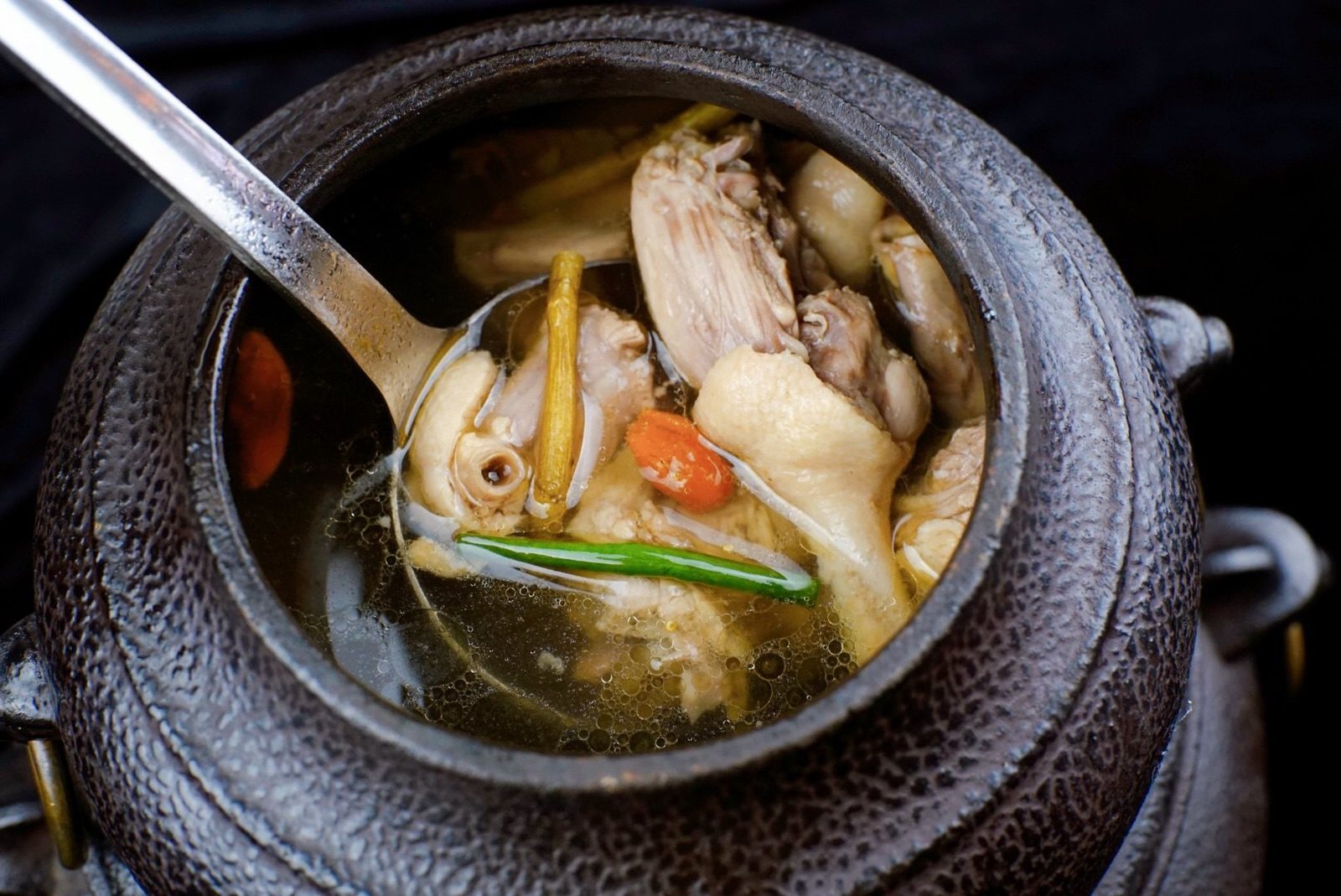
At the table it is plain: a free-range local duck raised for more than two years, a few lengths of fresh dendrobium stem, a little yellow wine and salt, simmered for a full four hours.

Field Carp

In Yongjia the field carp are raised in the rice paddies. The rice shades the fish; the fish eat insects, loosen the soil and leave fertilizer behind. One field yields two harvests. The practice has been handed down in the Yongjia hills for more than a thousand years.

Field carp come in red, black, white and mottled; the red is the most prized, and farm households serve it to honored guests. There are two ways to eat it. One is fresh — braised, on the same table by the Nanxi River as local chicken, fried rice noodles and farmhouse tofu. The other is smoked into dried fish, then used to fry rice noodles.

Chicken

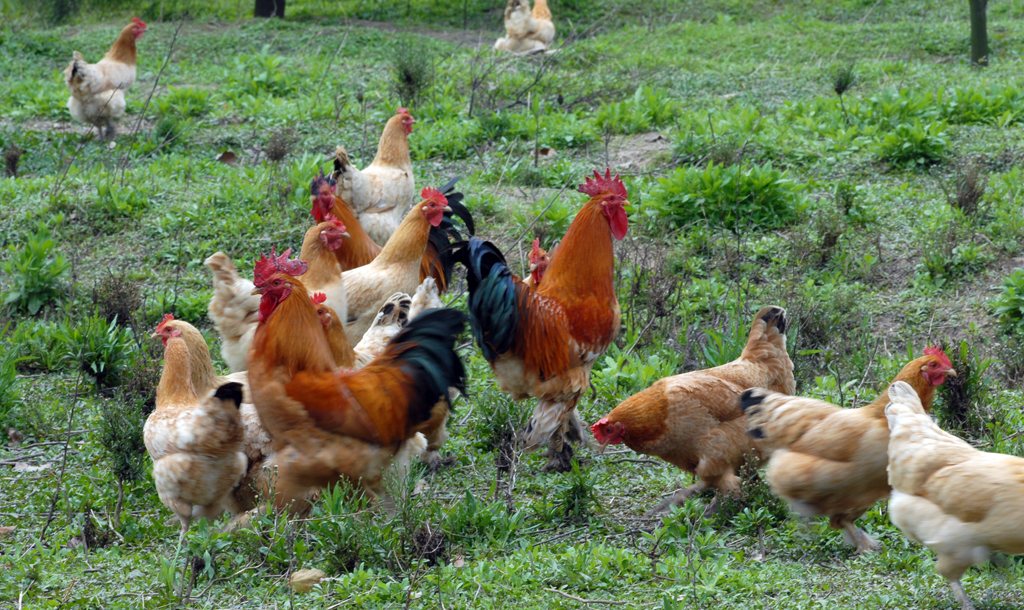
Wenzhou's chickens are raised mainly in Tengqiao in Lucheng district and in the Yongjia hills.

Tengqiao's scale grew out of contracts. A local livestock cooperative signed with more than 80 farming households nearby, supplying the chicks, the feed and the market. Of the city's sizeable poultry raisers, more than half are in Tengqiao.

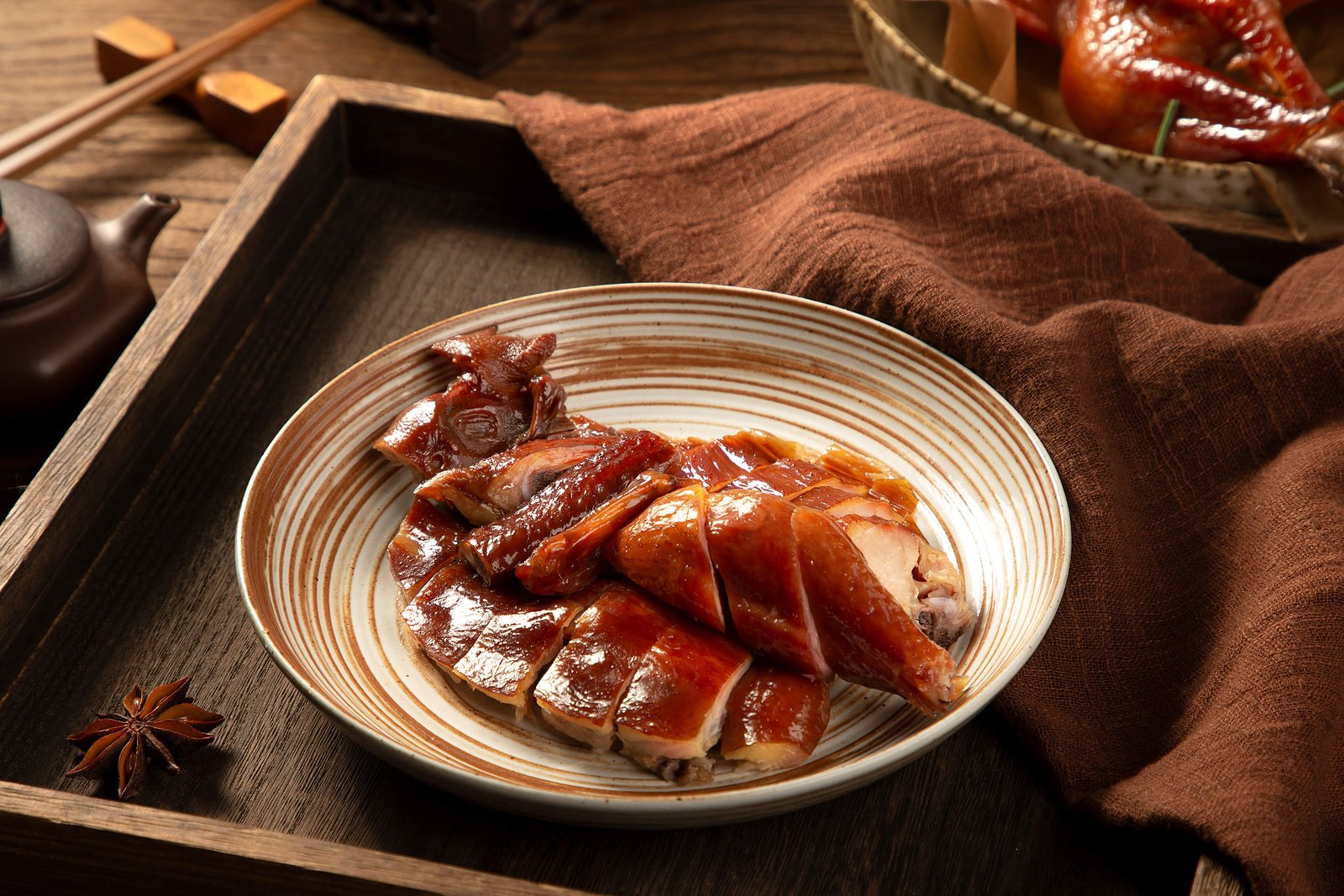
The most famous destination for these three-yellow chickens is smoked chicken. Rice husks, brown sugar and dried tangerine peel are set smoking under a wok; air-dried birds are hung above it, salted first and smoked after, taking color as they go. One account of its origin: on a Lunar New Year's Eve in the Jiajing era of the Ming, a sugar worker in Tengqiao took sugarcane bagasse from the sugar mill home to burn, and the smoke caught the cured chickens hanging over the stove. Steamed for the New Year's Eve dinner, the skin came out date-red, the cured flavor carrying a burnt-sugar sweetness. Sugar-smoking has been used on cured chicken ever since — and chicken at New Year carries the pun: *ji*, chicken, for *ji*, good fortune.

Smoked chicken is now one of Wenzhou's established intangible-heritage foods, and along with fish cakes and rouyan (pork-filled dumplings with meat-based wrappers) it is often held up as an example of heritage going industrial. At the end of the year it appears on the lists of New Year goods and gifts, alongside Ou mandarins, duck tongues and soy-braised pork.

In the Yongjia hills the method is different. Xialiao township is one of Yongjia's largest bases for local chicken; braised local chicken, local chicken with rice noodles and chicken offal stewed with mushrooms are the staple dishes there.

Tengqiao smoked chicken, cut into pieces on a striped ceramic plate, glossy mahogany, with a teapot, star anise and a wooden tray alongside
Image not loaded

Retry once you are online.

Tengqiao smoked chickenFile photo

The Sea Side

The rest lie in the tidal flats and the shallow sea.

Sargassum

Dongtou is an island district: some 300 islands scattered over more than 2,000 square kilometers of sea. Locals group yangxicai (Sargassum fusiforme, commonly known as hijiki), laver and large yellow croaker as "two vegetables and a fish". All three have been farmed for many years, and Dongtou has become the country's largest base for farming, processing and exporting sargassum and laver.

There are more ways to eat sargassum than one might expect. At Dongtou's sargassum festival the stalls hold it fresh and pickled, along with sargassum pancakes and fried fish cakes.

Sea Cucumber

South from there is Xiaguan in Cangnan, a major fishing town on the southern Zhejiang coast that takes the waves head-on every typhoon season.

Sea cucumber farming at Xiaguan was forced by typhoons. One household had raised large yellow croaker for more than twenty years when a single typhoon swept the whole stock away. The family talked it over and switched to sea cucumber, for a very practical reason: the sea cucumber season falls outside the typhoon months. Some of the fishermen around them switched with them.

In Dalian in the north they enclose a stretch of sea and release the seed; Xiaguan hangs its cages in moving water, which also keeps the silt down. Seed goes in around National Day and every cage is lifted before the following May Day — just clear of the typhoon season.

To the local farmers, sea cucumber is Wenzhou's third mariculture industry after large yellow croaker and laver. The road has had its rises and falls. When prices were good, close to a hundred households were farming it. Then the price fell by more than half; some left, some changed trade.

Dried Shrimp

Each township along the Cangnan coast has its own signature: Zaoxi's yellow cattle, Juxi's black goats, Yanpu's large yellow croaker, Xiaguan's dried shrimp.

In the years when inshore stocks were declining, Xiaguan's fishermen found a way out for the small shrimp: processed into dried shrimp, while the red shrimp became dried shelled shrimp and shrimp meat. Xiaguan later started a dried-shrimp festival, stringing a market a kilometer long along the old street, with stallholders opening at first light.

At Xiaguan, dried shrimp is rarely eaten on its own. What the town recommends is Xiaguan fish balls, dried shrimp, wine-scented yellow croaker and seaweed cakes. Walking along Jinsha Road, the old street, the seafood market and the fishermen's wharf line up one after another. Dried shrimp, sea cucumber, yellow croaker, grouper, oysters and laver sit on the same row of stalls. They share one sea, and one menu.

Seven Coordinates

The seventh is the large yellow croaker, first on the list of Wenzhou's ten premium agricultural zones. It also has the longest story — from wild fish to deep-water cages, from a netless acoustic ranch to a sea route out of an ancient port a thousand years ago. That story waits for chapter six.

Laid out flat, Wenzhou's freshness comes from two places only. In the hills, dendrobium grows on the slopes of Yandang Mountain, field carp swim in the rice paddies of Yongjia, and chickens are raised in the mountain villages of Tengqiao and Xialiao. In the sea, sargassum hangs in the shallows off Dongtou, sea cucumber hangs in cages at Xiaguan, and dried shrimp come ashore at the fishing port.

Seven things, each keeping to its own place and season: seven coordinates of one stretch of land and water.

Duck stewed in a clay pot with dendrobium, goji berries and spring onion
Image not loaded

Retry once you are online.

Old-duck pot with dendrobiumFile photo

At eleven the market crowd thins and the kitchen fires come up. By noon all of this freshness has to gather into one table.

Sources6 items
  • Wenzhou has built ten premium agricultural zones including large yellow croaker and dairy, accumulating 25 national agricultural honors. (Report of 13 May 2022)
  • Yueqing's Dendrobium officinale was named to Zhejiang's 2021 premium agricultural zone list; the provincial intangible-heritage workshop for Yueqing fengdou has lifted more than 3,000 farming households in Longxi and other old mountain districts, adding 15,000 yuan a year per household. (Reports of 16 November 2021 and 24 May 2023)
  • Rice-paddy fish farming in Yongjia goes back more than 1,300 years; in 2008 the county was named China's home of the field carp, with over 80,000 mu of paddy under fish at the time. (《永嘉获中国田鱼之乡金名片 全县稻田养鱼8万多亩》, 1 September 2008)
  • The Minxin livestock cooperative in Tengqiao signed order contracts with more than 80 farming households; the area's three-yellow chickens reach 20 million head a year, supporting over 2,000 jobs, and Tengqiao accounts for more than half of the city's 63 large poultry raisers. (3 July 2013; 《一只三黄鸡 "定义"一个镇》, 23 September 2022)
  • Dongtou's "two vegetables and a fish" — laver, sargassum and large yellow croaker — all hold national honors, with the China Fisheries Association naming the district China's home of laver and of ecological large yellow croaker. (Reports of 9 February, 18 March and 12 October 2021)
  • Dried-shrimp processing at Xiaguan began in the early 1990s; the first Xiaguan dried shrimp festival opened in 2023; the Huasheng brand was voted one of the ten branded agricultural products of 2018. (Reports of 3 August 2004, 14 November 2018 and 18 November 2023)
Next watch · 11:00–13:00Wu · One Table of Wenzhou

Image note · No usable photographs yet of the four regional ingredients — paddy-field carp, sargassum, sea cucumber and dried shrimp. They are on the shooting list; unrelated images were not substituted.

Chapter 05 · Wu11:00–13:00

One Table of Wenzhou

Raw crab in a red porcelain bowl, scattered with minced garlic, spring onion and chilli rings, on a black tray over ice
Image not loaded

Retry once you are online.

Cold dish first: raw crabFile photo

At noon, the banquet opens.

A visitor eating Wenzhou cuisine for the first time usually asks which dish it is famous for. Wenzhou people often cannot answer. Wenzhou cuisine is not counted in dishes but in a table: how the cold appetizers are arranged, in what order the hot courses come, what closes the meal. That structure explains Wenzhou cuisine better than any single dish.

Cold Appetizers, the Opening Line

When Wenzhou people give a banquet, the minimum for cold appetizers is four. The chef Pan Xiaolin, drawing up a menu for the 10,000-Person Wenzhou Cuisine Banquet, gave one example: white-cut chicken, jellyfish, fish cake, dried eel. The rest follow the season — blood clams, soy-sauce pork, blanched prawns are all in reserve.

Cold appetizers are the easiest to read and the first place the craft shows. Fish cake means scraping fresh fish into paste, throwing it down until it binds, then steaming; cut open it is white inside and yellow out, which people call "gold and silver". Duck tongue is glossy red, salty-sweet with a returning finish, and one duck yields a single tongue.

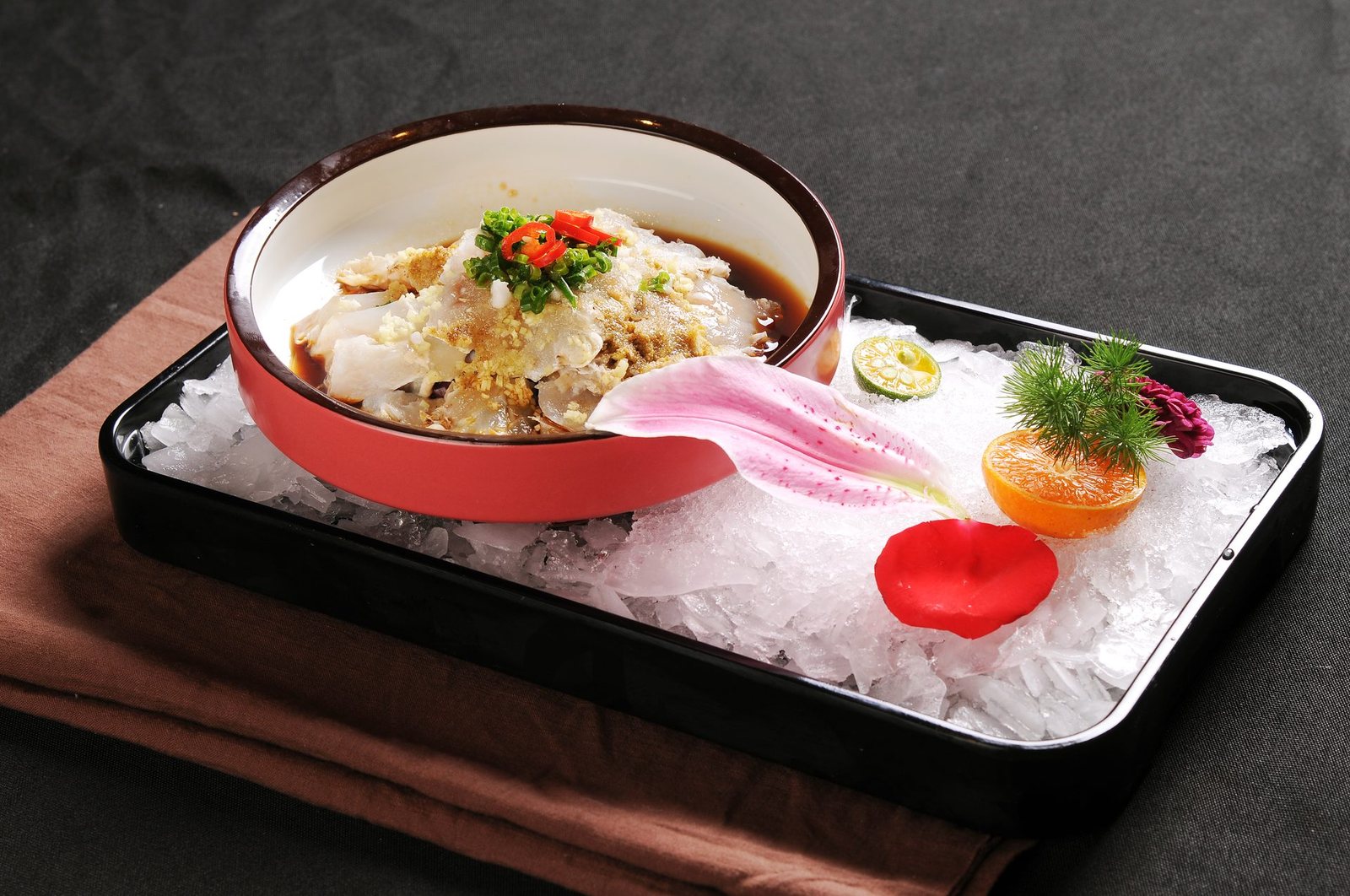
Jiangxie Sheng is the touchstone among cold appetizers. Live swimming crab cut into pieces, dressed with rice vinegar, soy sauce, sugar, Shaoxing wine and minced ginger, left to steep for a quarter of an hour, then chilled and eaten cold. The method can be traced to "hand-washed crab" of the Southern Song. Order it and a restaurant's craft is more or less settled. Raw-marinated seafood carries food-safety risk: the crab must come live from a proper supplier, and pregnant women, children and anyone with a delicate stomach should not eat it.

The Heavyweights Among the Hot Courses

The cold appetizers come off and the main courses go on.

Pan Xiaolin named four dishes that Wenzhou people hold up at a banquet: San Si Qiao Yu, brocade fish shreds, fish skin with garlic, and oil-burst cuttlefish. Plenty of Wenzhou cuisine chefs take them to national culinary competitions. Three of them — pounded fish, brocade fish shreds and the cuttlefish — are known together as the three peaks of Wenzhou cuisine.

A selection of ten classic Wenzhou dishes gave a longer list: San Si Qiao Yu, mud crab with egg white, oil-burst cuttlefish, fish skin with garlic, eight-treasure rice, whole chicken with pickled greens, wonton with sea cucumber, pork tripe with peanuts, wine-braised mantis shrimp, and deep-fried sweet-and-sour yellow croaker.

Many of these were forced out of lean years. In the 1970s transport was poor and freight unreliable, so cooks worked with whatever local ingredients were at hand and produced crisp fish steak, sweet-and-sour yellow croaker, fish skin with garlic and steamed soft-shell turtle. Earlier still, snowflake shark fin, boned soft-shell turtle, dragon-and-tiger yellow croaker, double-crisp, dry-fried crab and braised pork chop all had their day.

Wenzhou dish names often carry a blessing. Braised pork with dried bamboo shoots asks for "a good opening"; mud crab with egg white is "like a flower, like jade"; cuttlefish with glass noodles is "black and white in clear contrast". What sits on the table is food. What is being said is a good omen.

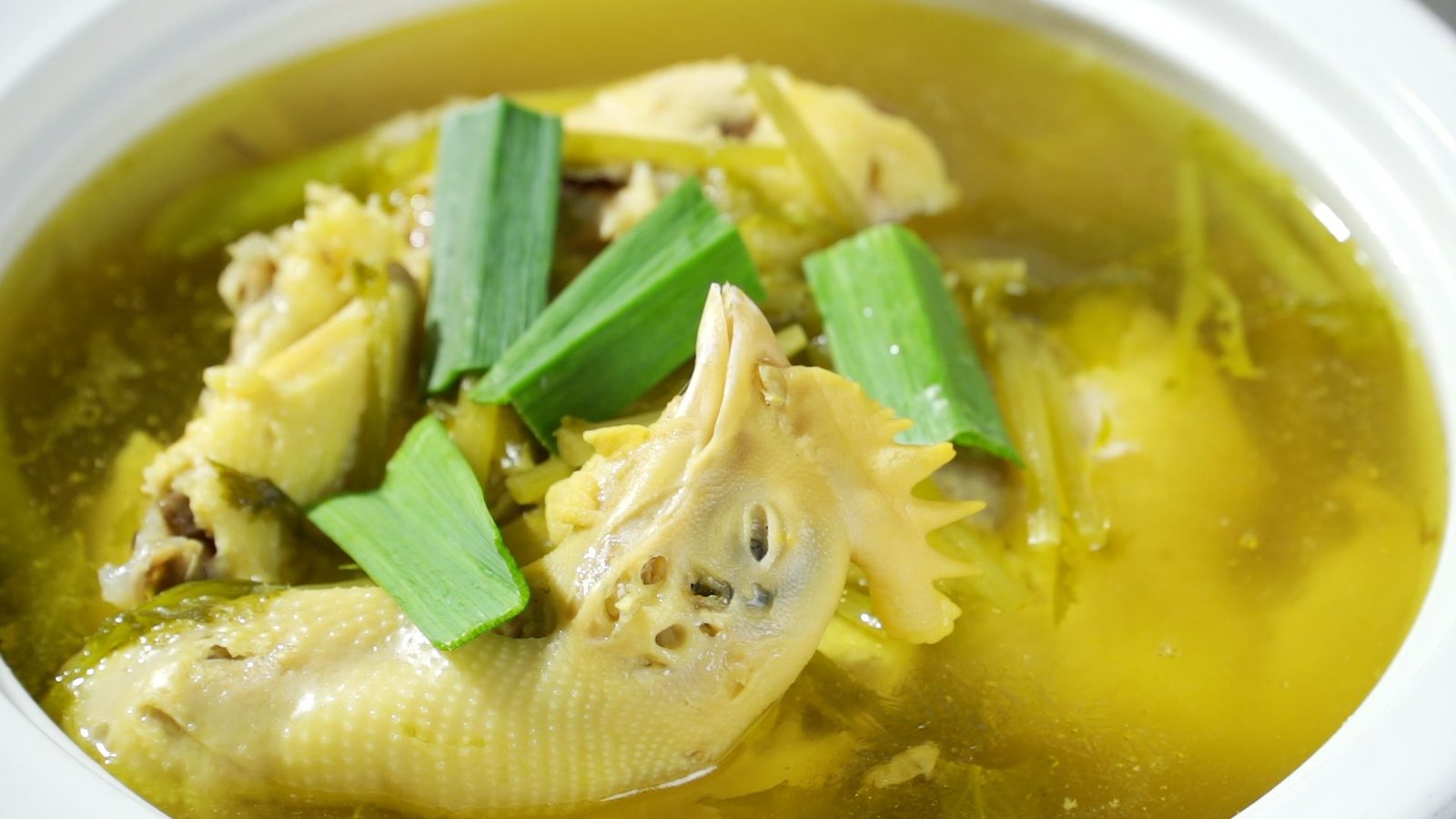
Whole chicken stewed with pickled greens, garlic sprouts on a golden broth, in a white porcelain basin
Image not loaded

Retry once you are online.

Whole chicken with pickled greensFile photo

How a Table Gets Decided

A table can be arranged this neatly only because it was named and written down, again and again.

In the 1950s Wenzhou's first state-run restaurant opened, and more than forty Wenzhou dishes were collected into *Zhongguo Caipu* (Chinese Recipes). For the first time the cuisine had a source text. Three-shred pounded fish later entered a new edition of the same book.

In the 1970s experts took the name of the Ou River and formally named this local cuisine Ou cuisine, summing up its character in four lines — two light, one heavy: seafood at the center; light oil, light thickening, and heavy knife work; clean fresh flavors, delicate rather than thin; and cooking that prizes finesse and elegance.

A name still needed a manual. Only after *Zhongguo Ou Cai* (Chinese Ou Cuisine) was published did the cuisine stop being "dishes without a book". Pan Xiaolin is more precise in its pages: fine fresh ingredients, light flavors, heavy knife work, respect for natural beauty, a smooth mouthfeel. And above all the same six characters: light oil, light thickening, heavy knife work.

Today's Table

The menu is not fixed. Signature dishes like horse-bell yellow croaker have grown rare as the ingredient thins out.

New ones have grown too. The Dragon Boat Festival edition of the 10,000-Person Wenzhou Cuisine Banquet laid out four cold appetizers and ten hot courses, plus a sweet soup and seasonal fruit. Seasonal fruit was folded into the cold appetizers: white-cut chicken with yangmei (Chinese bayberry) became "the phoenix offers an auspicious scene"; anchovy with lychee, "sails set to the waves"; cuttlefish with loquat, "pearls brighten the festival"; duck tongue with Jiangxie Sheng, "Ou notes salute the day". The hot courses ran five-color dragon-boat rice, yellow croaker in scallion oil, a raw-drunk platter of small lobster, braised sea cucumber with garlic, steamed mud crab with sweet potato, salted nine-segment prawns, roast black pork with salad, pounded fish and quail egg soup, and stir-fried greens — closing with a Wenzhou Dragon Boat thin pancake.

The names change; the order does not. Cold appetizers open, main courses hold the room, sweet soup closes.

The table left Wenzhou long ago. When the banquet opens, the tables are set at the same time in city hotels and in hotels across France, Germany, Italy, the Netherlands, and Spain, and in Hong Kong, China, Shanghai, Guangzhou, and Lanzhou. The method is unusual: masters set the menu, the government subsidizes the cost, the hotels give up their margin. More than a thousand tables open at once, and the seats are filled by locals.

A Wenzhou table is a list and a set of rules at once. It requires produce: jellyfish, dried eel, Jiangxie Sheng, yellow croaker, mud crab, sea cucumber, all of it out of the East China Sea. It requires craft: the mallet for pounded fish, fish shreds that do not break on the chopsticks, a dressing steeped to the exact minute. And it requires an order of hospitality — who comes first, who closes, when the sweet soup is carried out. The human relations are arranged inside it.

So the question of which dish represents Wenzhou cuisine is already the wrong question. Its representative work is a table.

A little after one the table breaks up and the tide begins to fall. Another lesson in freshness is starting at the water's edge.

Sources4 items
  • Wenzhou's first state-run restaurant opened in 1956; in 1959, 46 Wenzhou dishes were included in Zhongguo Caipu (project-verified material); the 1977 edition of the same book includes San Si Qiao Yu. (Report of 1 December 2022)
  • The name "Ou cuisine" was formally adopted in the 1970s, taking the Ou River as its source, with a twenty-four-character summary of its character. (Project-verified material)
  • The World Wenzhou Cuisine Banquet for Ten Thousand has been held since 2015, when 12 city hotels linked with more than 20 hotels at home and abroad; by 2024 it had run six times, the 2024 edition hosted by 21 hotels across Lucheng, Longwan, Ouhai, Dongtou and the marine economic zone. (Report of 14 December 2015; 《瓯菜天下鲜!世界瓯菜万人宴开宴》, 27 January 2024)
  • The cold and hot dish line-up for the 2026 Dragon Boat banquet comes from the year's copy returned by the hub; that copy carries a system placeholder date and its original address could not be located.
Next watch · 13:00–15:00Wei · Between Mountain and Sea

Chapter 06 · Wei13:00–15:00

Between Mountain and Sea

Aerial view of islands under dense vegetation, with aquaculture cages and wind turbines on the water
Image not loaded

Retry once you are online.

Island chain and sea pastureFile photo

The busiest meal of the day is over. In a fishing-port city, the hours that follow belong to the sea.

A fishing port does not run on an alarm clock. It runs on the tide table. When to go out, when to come back, when to unload — the water level decides. By the time the rhythm reaches the table it has faded a great deal. Most people notice the sea has changed season only when the closed season ends and the seafood stalls suddenly carry a great deal more.

A Fish Raised in the Sea

Dongtou is one of China's fourteen island districts and counties, with more than 300 islands scattered off the mouth of the Ou River. Further south, the Nanji Islands lie off Pingyang. A warm current from the south meets the Zhejiang–Fujian coastal current here, the feed is rich, and this is one of the northernmost stretches where large yellow croaker can overwinter naturally.

Nanji large yellow croaker first carried the identity of a place of origin. It holds a certificate of geographical indication of origin, protected on the same footing as Wenzhou aged wine, Pingyang water bamboo shoots and Dongtou sargassum. Locals call the certificate the fish's passport.

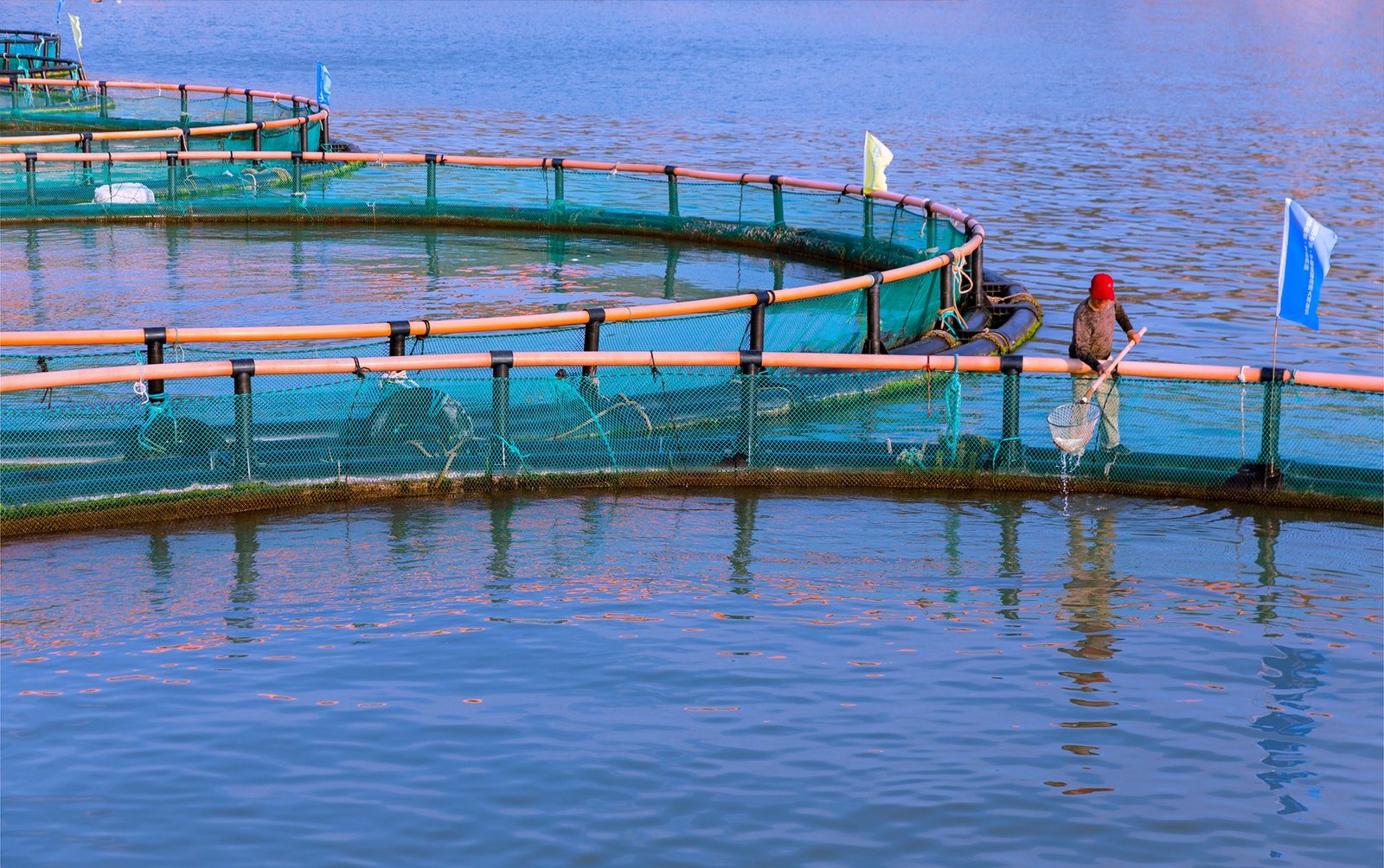
The method has changed several times. Deep-water cages were introduced from Norway early on. At one farm off Nanji, ninety deep-water cages sit on 200 mu of sea. A larger round of rebuilding followed: more than 200 deep-water storm-resistant cages replaced the old small cages and shallow nets, pushing the farming zone further out, and the quality of the fish came up with it. Nanji large yellow croaker went on to be served at the state banquet of the G20 summit in Hangzhou.

Dongtou's Luxi Island took another route: take away the nets and use sound instead. Ten smart buoys float in the water off Wuren'ao, emitting sound at a set frequency and holding the fish inside a natural bay. The first 200,000 fry "checked in on hearing the sound"; more were released in later batches.

In this water there are only 0.2 fish per cubic meter, far below conventional stocking density, and no artificial feed is used. Luxi alone already produces more than 2,700 tonnes of yellow croaker a year.

Aquaculture cages off Nanji Island; a worker on an orange walkway works a hand net
Image not loaded

Retry once you are online.

Sea cages off Nanji IslandFile photo

Wenzhou cuisine has a saying: no banquet without yellow croaker. It is about more than taste. It is about supply. Whether the fish can reach the table reliably depends on whether this stretch of sea can deliver reliably.

The Port: Gathering What Is Caught

Before a fish reaches a table it has to pass through a port.

Dongtou is Zhejiang's second-largest fishing ground, with more than 4,800 square kilometers of fishable water and fifteen ports. The Yuao central fishing port is the largest national-level central port in southern Zhejiang.

The Dongtou fishing-port economic zone is now a national pilot, planned across more than 800 square kilometers, most of it sea. The layout is one core, two zones and several points: Yuao is the core, handling general services, deep processing of seafood and marine biomedicine; the Dongsha area does support services and coastal tourism; the Luxi area does mariculture and recreational fishing; the rest are scattered across the islands, with the laver industrial park on Niyu among them.

The difference between this and an old fishing port is written into the entry requirements: a national-level central port, and a market able to carry 100,000 tonnes of catch a year. What is wanted is not a place to tie up boats but a complete chain — unloading, trading, cold chain, processing.

Further south, laver from Cangnan is both an everyday dish and, out at sea, a garden under cultivation.

The distance from origin to table can sometimes be measured. At the Zhejiang agricultural expo, the Nanji large yellow croaker sold out before the fair had closed.

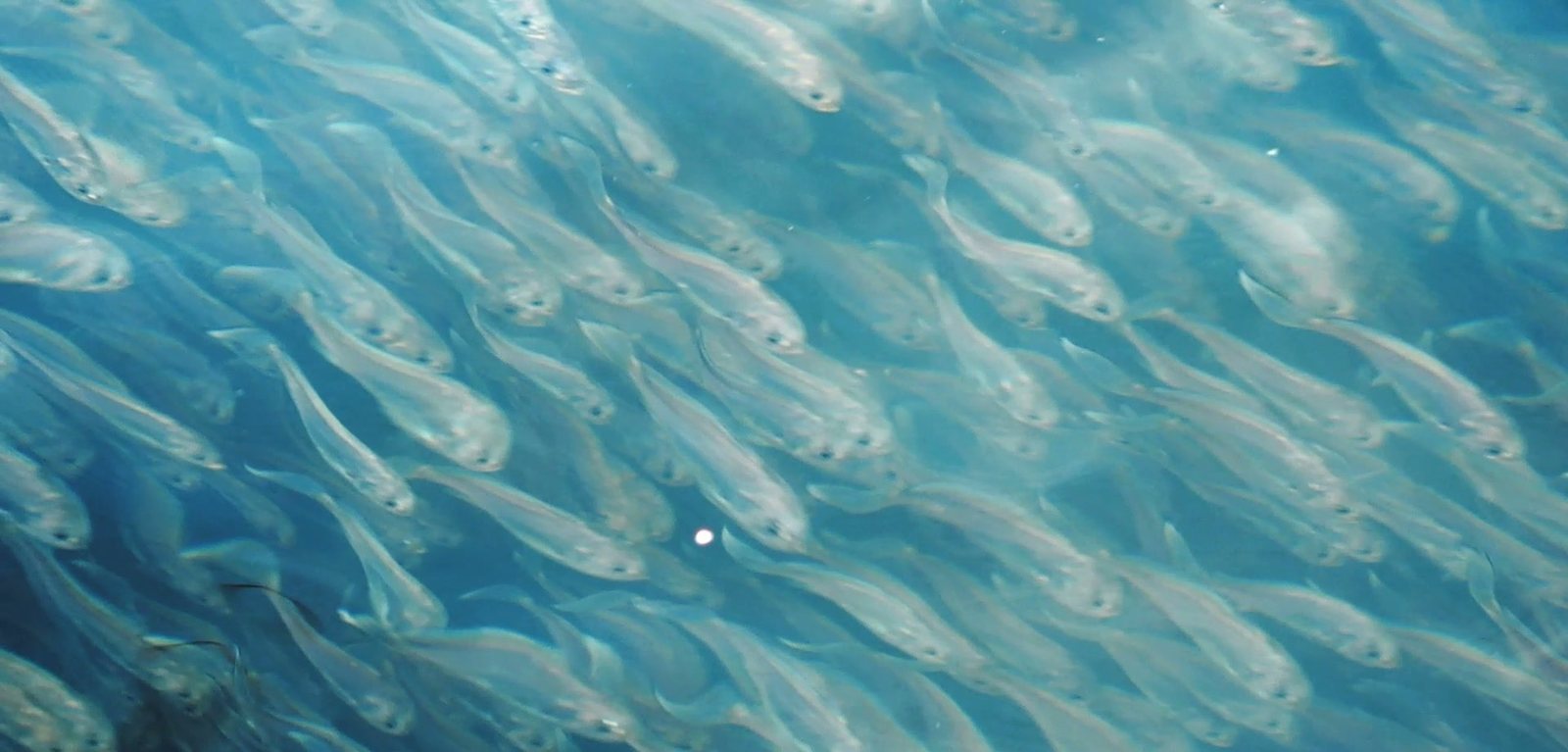
A dense shoal of large yellow croaker in clear water
Image not loaded

Retry once you are online.

Large yellow croaker in clear waterFile photo

A Sea Route a Thousand Years Old

Farming and gathering are present-day matters. This sea route is far older.

The keel of a Southern Song Fujian-style ship lies in the Shuomen ancient port site. The porcelain sherds recovered there are measured in tonnes, more than nine-tenths of them from Longquan kilns. Beside two Northern Song wrecks, more than 30 tonnes of Longquan celadon fragments lie in layer upon layer.

More than a thousand years ago Longquan porcelain changed ships here and went out to sea along the maritime Silk Road. The city itself was built to the port. Guo Pu chose the site and laid out Wenzhou's "dipper city" on the principles of sitting by the river, reaching the water and backing onto the hills.

In the Yuan dynasty the Wenzhou man Zhou Daguan sailed from here to Zhenla and wrote *Zhenla Fengtu Ji* (The Customs of Cambodia). Seven hundred years later the voyage was remade as a documentary, *Shuomen Crossing: The Road to Zhenla*, using AIGC. The discovery of the Shuomen port is also regarded as important support for the maritime Silk Road's world heritage bid.

At one end of the route, porcelain and lacquerware; at the other, foreign lands. The port joined the two. This is what "shipping out" looked like at the very beginning.

The Mountains Keep the Calendar Too

It is not only fish that keep to the calendar.

Wencheng's glutinous yam is an old local variety; cooked, it eats like rice cake or glutinous rice, which is where the name comes from. Yongjia's Wuniu early tea wakes before spring does.

Ou Mandarin (Ou Gan) has been grown in the Sanyang wetlands of Ouhai for more than a thousand years. Of the 161 islets in the wetland, everything that is not lived on is mandarin grove. Picking starts around the Minor Snow solar term, when the fruit carries the most sugar and the fullest flavor.

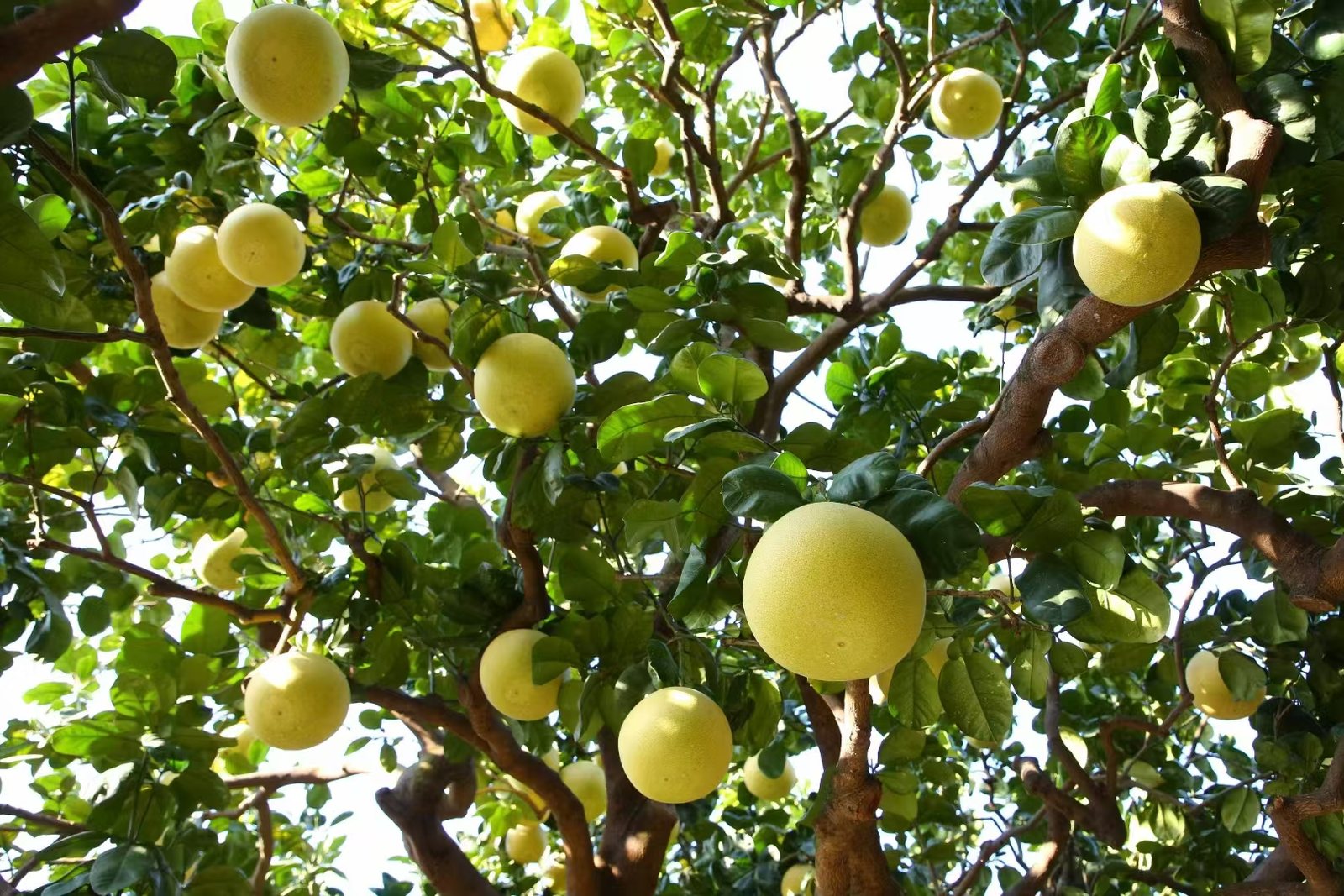
Pomelos hanging heavy among green leaves in an orchard
Image not loaded

Retry once you are online.

A pomelo orchardFile photo

Fish are fattest in autumn; laver waits until after November; the yam comes after Frost's Descent; tea before spring; mandarins just ahead of the year's end. Each keeps its own season — and that is where the freshness of Wenzhou cuisine comes from.

Farmed, caught, shipped out, and grown to the calendar in the hills — put together, that is the table of a city that sits between mountain and sea.

None of it can be hurried. The sea can wait, the fish can wait, the solar terms can wait. There is one thing that cannot be waited back: craft.

At three in the afternoon, the sound of the chopping board is about to start.

Sources6 items
  • Dongtou is one of China's 14 island districts/counties, with 302 islands; the district has 15 fishing ports, 5 of them graded. (Reports of 2 January 2020 and 20 April 2023)
  • In 2005 Pingyang's Nanji large yellow croaker received a certificate of geographical indication of origin from the national quality inspection authority, Wenzhou's sixth protected product of origin; deep-water cages were introduced from Norway in 2004, and 246 storm-resistant deep-water cages later replaced the small ones; the fish was selected for the state banquet of the Hangzhou G20 summit. (《南麂大黄鱼领"护照" 原产地保护产品又添新丁》, 16 July 2005; report of 30 April 2021)
  • Dongtou's netless acoustic sea ranch at Luxi went into use at the end of 2022, developed by a company with the Chinese Academy of Sciences acoustics institute and other teams; the first batch was 200,000 fry. In 2025 another 30,000 were released at an average weight of 200 grams; that year Luxi's yellow croaker output exceeded 2,780 tonnes, worth 250 million yuan. (Reports of 21 December 2022, 22 April 2025 and 20 July 2026)
  • In 2023 the Ministry of Agriculture and Rural Affairs published its national coastal fishing-port economic zone pilot list, 10 nationwide; the Dongtou zone was selected, with 260 million yuan in central and provincial subsidies, positioned as a "future fishing port, pearl of the garden". (《人民网:温州市洞头区渔港经济区入选国家级试点名单》, 20 April 2023)
  • At the 2025 Zhejiang agricultural expo, large yellow croaker from Nanji Island in Pingyang sold out the day before the fair closed. (Report of 26 November 2025)
  • In 1296 the Wenzhou man Zhou Daguan sailed from the Shuomen port to Zhenla and wrote Zhenla Fengtu Ji; an AIGC documentary, Shuomen Crossing: The Road to Zhenla, later recreated the voyage. (Report of 1 August 2026)
Next watch · 15:00–17:00Shen · How a Dish Stays

Image note · No usable photographs yet of the fishing port, laver farming or the mountain crops (yam, Wuniu Early tea, Ou mandarin). They are on the shooting list. The pomelo image is a media-library file showing a different crop from the one described, and stands only for the mountain season.

Chapter 07 · Shen15:00–17:00

How a Dish Stays

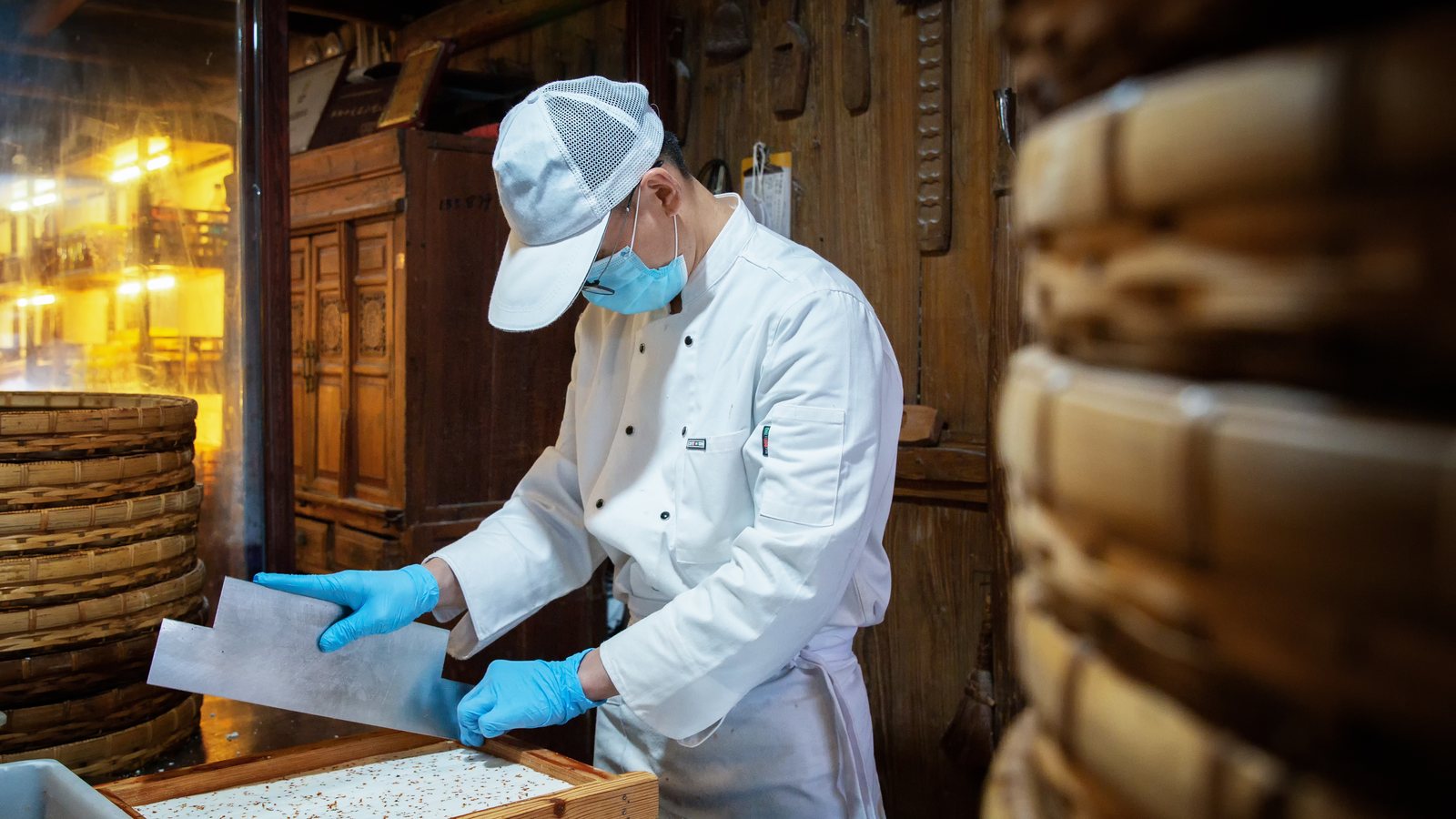
In an old workshop a master in white coat, mask and gloves bends over a wooden tray, levelling rice flour with a scraper; bamboo steamers stack on both sides and warm light comes through a latticed window
Image not loaded

Retry once you are online.

Craft in an old workshopFile photo

At three in the afternoon a sound comes out of the lanes of the old town.

Tok, tok, tok. A wooden mallet falls on a chopping board, one stroke after another, even in rhythm. Anyone hearing it for the first time will guess wrong: it is not a wooden fish being struck, nor pork ribs being chopped. It is pounded fish. Walk along the old street and you will often see a woman sitting facing the window, working in the afternoon light, beating a piece of fish thinner with every stroke.

A Piece of Fish, Beaten into a Sheet

The name that rolls off the tongue is San Si Qiao Yu — pounded fish consommé with three shreds. The method sounds too simple for a famous dish: dip the fish in dry starch, beat it into a sheet with a wooden mallet, boil it and add garnish to make a soup. Done for real, every step has its rule.

Fish first. Popular practice rates mi-iuy croaker and eel highest; yellow croaker and sea bass will do. The flesh must be fine and thick, the fish must be fresh, and only the clean meat is taken, skin and bone removed.

Then cut. The fish is cut into irregular pieces about the size of a block of dried tofu and tossed in starch. More starch goes on throughout the beating to stop it sticking to mallet and board, and the piece is turned often so the thickness comes out even.

Then the mallet. Wenzhou people call it the pounded-fish mallet, and it looks like a grenade one size up. It is used the same way as the laundry paddle at the river steps, but the force is entirely different. The laundry paddle swings wide and hits hard to drive dirty water out. The fish mallet strikes light and heavy by turns, even in tempo, flattening the meat quietly.

It counts as done only when it is white as jade and thin as paper.

The last step is the one outsiders most often miss. The finished sheet goes whole into boiling water for three or four seconds so the surface starch sets, and only then is it lifted out and cut into strips. Skip it and the pot turns to paste.

Red, Yellow and Green on White

A bowl of San Si Qiao Yu has rules about color: the fish must be white, the garnish must alternate red, yellow and green.

There is no agreement on which three shreds they are. The version told most widely today is chicken breast, ham and shiitake. Earlier it was ham first, with bamboo shoot and greens. The garnish has shifted with the decades and the shop; the rule about color has not.

The broth has to be clear. The verdict is always the same eight characters: clear broth, mellow taste, tender and smooth. Look at the color when it reaches the table, take one spoonful, and you know whether it was done right.

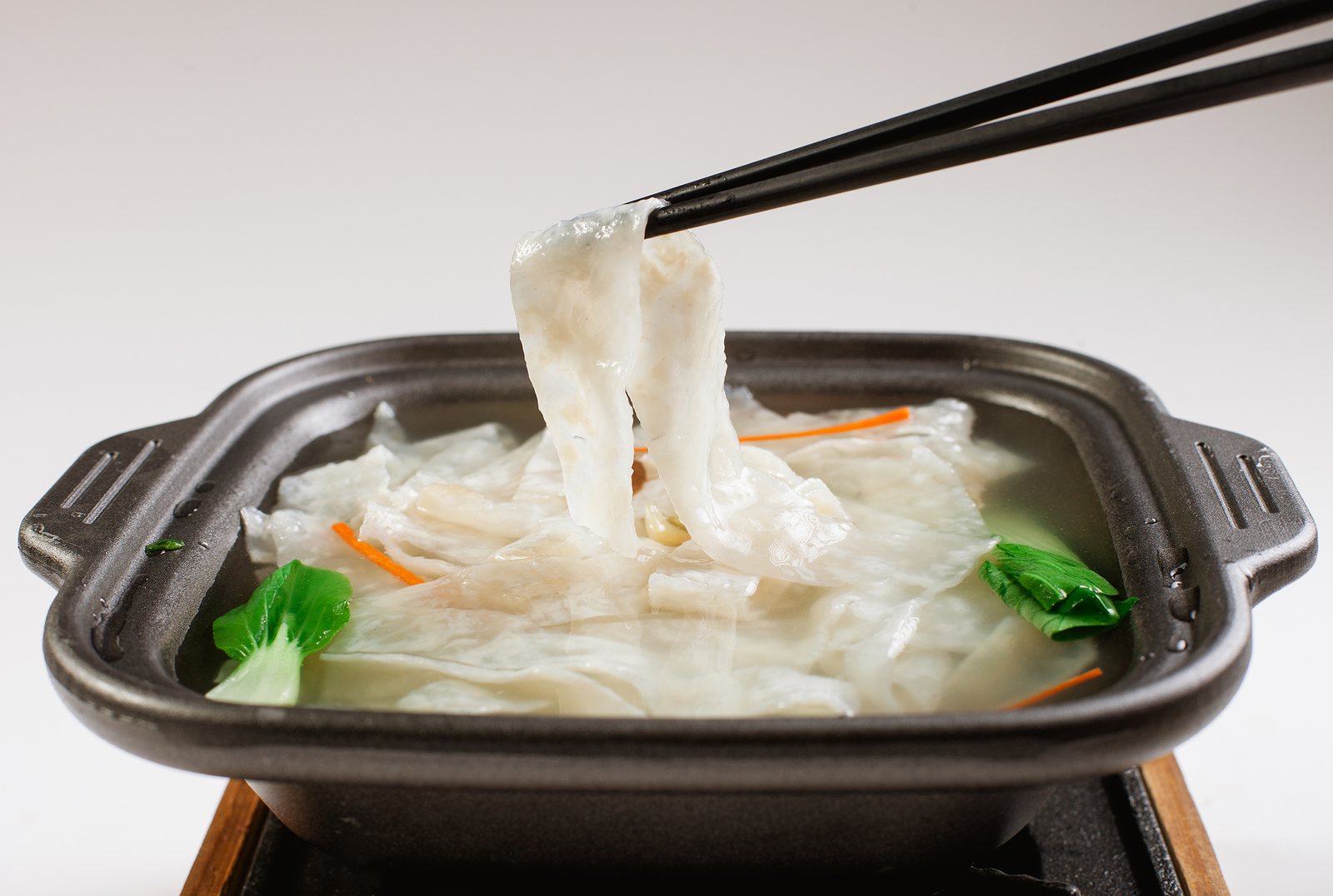
Wenzhou pounded-fish soup in a black clay pot, slices thin as paper with greens and shredded carrot, one lifted by chopsticks
Image not loaded

Retry once you are online.

Pounded fish with three shredsFile photo

Heavy Knife Work

Why did pounded fish in particular become the face of Wenzhou cuisine? Of the summary in chapter five, the words "heavy knife work" land most plainly here.

Getting a piece of fish thin enough to see light through is not a matter of recipe. It is decades of judgement stored in the hands. Wenzhou's Chinese-cuisine chef competition sets aside a "decorative cold plate" round to test knife work, and the marking standard reads "handsome in form, fine and precise". What the judges watch for is exactly that weight.

Why It Gets Remembered

There is a story about where pounded fish came from. In the Daoguang reign of the Qing, someone traveling by boat to Fujian saw yellow croaker glittering at the side of a fishing boat. The fisherman took off the head, skinned it, cleaned it, sliced the meat and spread the slices on the gunwale, hammering them into thin rounds like flatbread and drying them. The people on the boat cut the dried fish into shreds and boiled them into soup, and found it startlingly fresh. Others copied it, and pounded fish became a dish in every household.

Beyond the story, it has been on two lists that carry weight. When the Zhejiang volume of *Zhongguo Caipu* was compiled in the 1970s, San Si Qiao Yu entered it along with horse-bell yellow croaker, sweet-and-sour yellow croaker, mud crab with egg white and other Wenzhou dishes, ten in all. Later, the cooking techniques of Wenzhou cuisine was inscribed onto Zhejiang's provincial intangible cultural heritage list.

Between a dish every household can make and a dish written into a book and onto a list, the thing in between is the act of recording.

Whose Hands the Craft Is In

A craft survives if two layers of people catch it: one layer writes the technique onto a list, the other writes the feel of it down as data.

The provincial inheritor list keeps getting longer. In the most recent batch, Wenzhou's numbers rank near the top in the province, with traditional crafts the largest category — the making of Yongjia wheat cake and of rouyan among them.

There are plainer ways of catching it too. Wang Yongliang has made wheat cakes for more than thirty years. Wu Shunhui, an inheritor of wheat strips, has digitally recorded the whole process. Chen Zhengmo, born in the 1990s, quit his job and came back to take up the old craft of dengzhan gao.

Fanshan Meat Swallow (Fanshan Rouyan) from Cangnan is another version of the same pounding logic. Only pork leg sold that day is used, nearly a third of it trimmed away as membrane, then beaten 8,000 times by hand with a mallet weighing a little over a kilogram, the meat held at about 18°C. Sweet potato starch and lotus starch go onto the paste, and after patting, pressing, rolling and grinding it becomes a wrapper thin and transparent as rice paper.

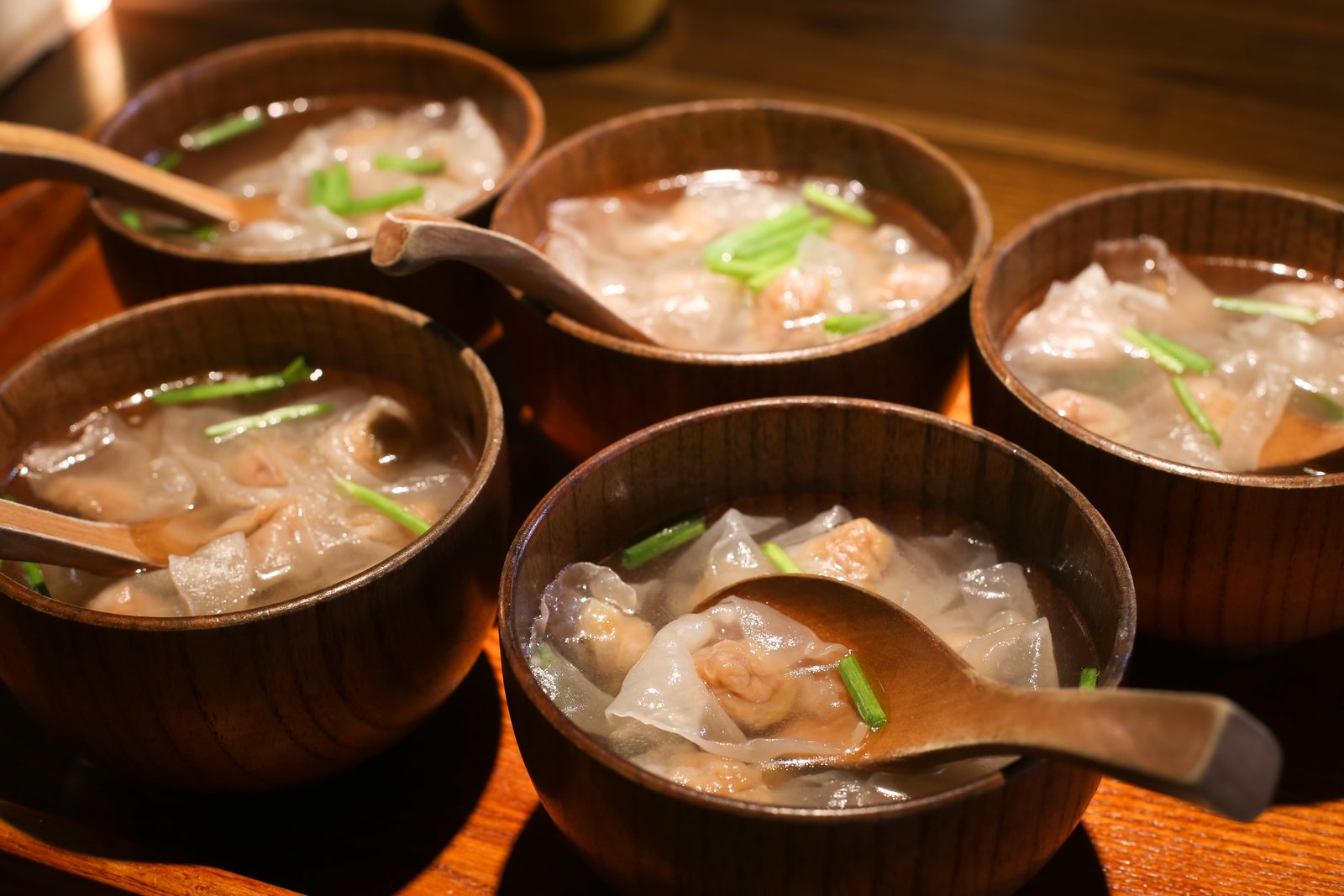
Meat yan in wooden bowls with a clear broth and spring onion, several bowls on a wooden tray
Image not loaded

Retry once you are online.

Fanshan Meat SwallowFile photo

For San Si Qiao Yu to be reproducible, the reasoning is the same: how much dry starch, how many seconds and at what temperature in boiling water, how many grams of each garnish — all of it has to be written down, with specific numbers replacing "a little" and "as needed". Old masters retire eventually. If the recipe says only "as needed", the craft breaks the moment the apprentice leaves. Writing a dish as data is the interface left for the next generation.

Back to the chopping board at three in the afternoon. Under the mallet the fish grows thinner and thinner, thin enough to let the light through from the window. The mallet technique, the garnish, the three shreds have all changed more than once. The act of pounding has not — because that is the only reason this dish is this dish.

At five the light drops and the dish is done. What comes next is carrying it out: today's Wenzhou cuisine — whose hands is it in?

Sources4 items
  • In 2017 Wenzhou held a city-wide Chinese-cuisine chef competition (Wenzhou cuisine techniques), with the decorative cold plate round testing knife work. (《温州厨星比拼"瓯菜技艺" 2017年全市烹饪大赛明日开锣》, 10 October 2017)
  • In July 1974 the Wenzhou catering company set up a compilation group for Zhongguo Caipu; Ye Guoguang went to Hangzhou to write the Zhejiang volume, which took in ten dishes including San Si Qiao Yu, horse-bell yellow croaker, sweet-and-sour yellow croaker and mud crab with egg white. (《独属温州人的记忆 中国烹饪大师解读瓯菜文化》, 12 January 2016)
  • The cooking techniques of Wenzhou cuisine was inscribed onto Zhejiang's provincial intangible cultural heritage list in 2011. (Report of 29 December 2015)
  • In the seventh batch of Zhejiang provincial intangible cultural heritage inheritors, 48 were from Wenzhou, across 11 categories, 17 of them in traditional crafts. (《温州48人入选第七批省级非遗代表性传承人!居全省第二》, 14 July 2026)
Next watch · 17:00–19:00You · Today's Wenzhou Cuisine

Image note · The chapter opener is a media-library file (pastry-making in an old workshop), not a photograph of the pounded-fish or meat-yan techniques described. Workshop photographs of both are still to come and are on the shooting list.

Chapter 08 · You17:00–19:00

Today's Wenzhou Cuisine

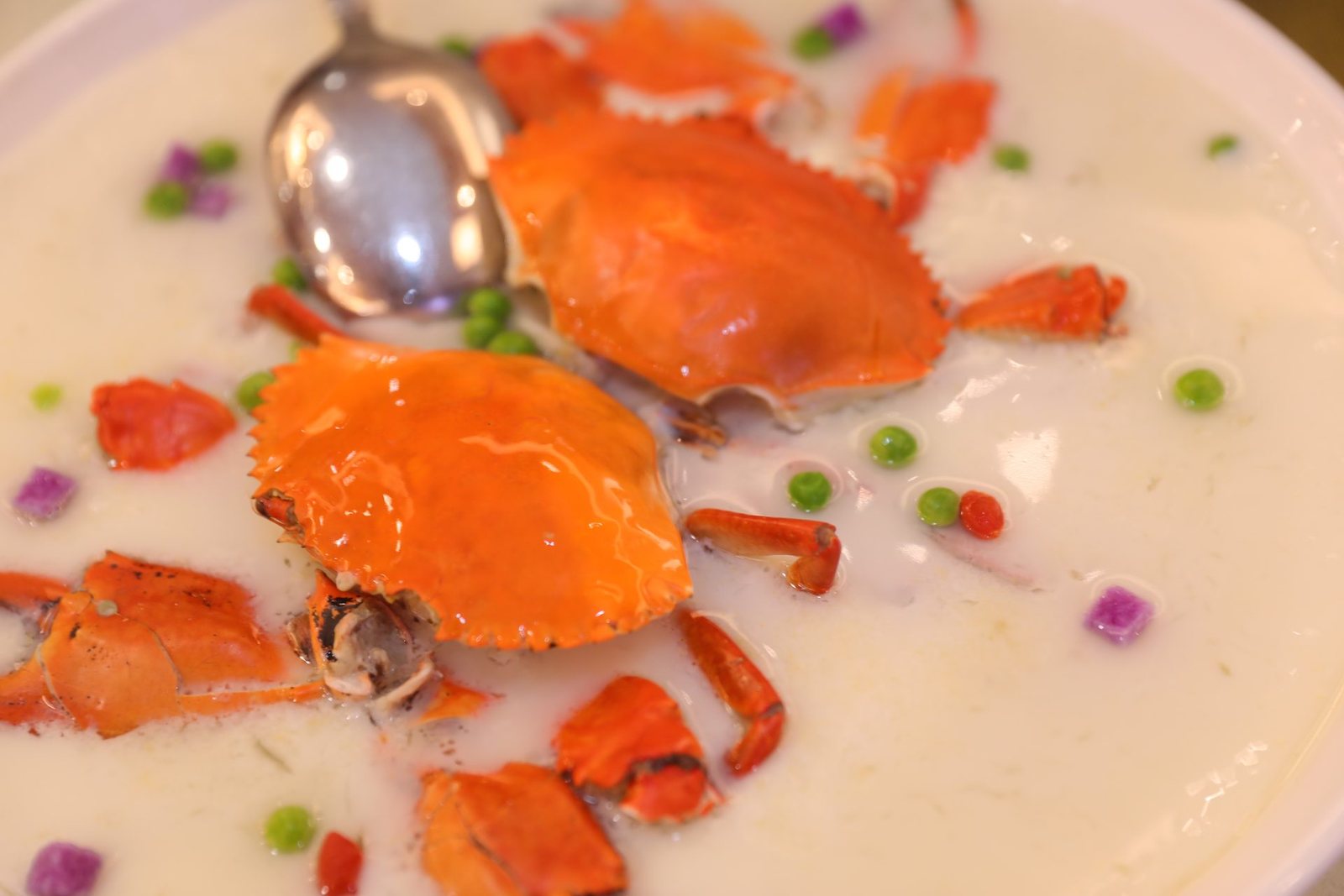
Mud crab in egg white: two orange-red shells and claws in a milky custard, dotted with green peas and purple spring-onion
Image not loaded

Retry once you are online.

Mud crab in egg whiteFile photo

After five the flame on the stove drops and the dishes are ready to go out.

Wenzhou cuisine is not a closed book. Since it was named in the 1970s the cuisine has been remade over and over: someone writes it into a book, someone carries it into competition, someone takes it apart into data.

After the Name, You Need People

A name alone will not hold a cuisine up. Someone has to do three things for it: write the dishes down, carry them onto the stage, and teach them on.

Jin Cifan was among the first to take it on, and one of the founders of the cuisine. He was chief editor of *Zhongguo Ou Cai* (Chinese Ou Cuisine). Before that, the craft existed only in masters' hands and apprentices' memory.

What lets one book hold a cuisine up is not prose. It is fixing, for the first time, something that had only ever passed from mouth to ear. Once that is done, the people who come after have something to build on.

Writing the Dishes Down

On this line the name that comes up most is Pan Xiaolin. He cooked at the Great Hall of the People early on and later received a special government allowance from the State Council. The *Zhongguo Ou Cai* he edited won a special contribution award at the Gourmand World Cookbook Awards, and on the day he collected it in Macao, China, he draped himself in the national flag.

The other half of writing down is counting which dishes have fallen behind. Horse-bell yellow croaker, mentioned in chapter five, is one. In his view the dish has slowly been forgotten as its ingredient grew scarce.

Carrying It onto the Stage

For a cuisine to be recognized from outside, someone has to score points for it in competition.

Zhou Xiong took first place at the first national young-workers cooking competition. He went on to head the China Ou Cuisine Research Institute and to serve as principal of the Jinding culinary school — research at one end, teaching at the other.

More recently there is Jin Huai. He created ten Wenzhou dishes on the theme of reform and opening, under the title "First Banquet of China: Ten Perfect Courses". The menu was not copied from an old recipe book. It was written from these last few decades.

Teaching It On

Xiang Zhaohui has stood at the stove for thirty years. What he cares about most is leaving a trace. Learning to cook at the Wenzhou Huaqiao Vocational Secondary School, he arrived at the shop earlier than anyone each morning to drill the basics, and after closing he wrote down that day's ingredients, heat and figures for every dish.

He is now compiling a *Standardisation Manual for Wenzhou Cuisine Techniques*, breaking the craft of more than sixty traditional dishes into quantifiable data so that every step, from ingredients to finished plate, can be reproduced and checked.

The previous chapter said it: old masters retire, and "as needed" will not hold a craft. What Xiang Zhaohui is doing is turning that sentence into a book.

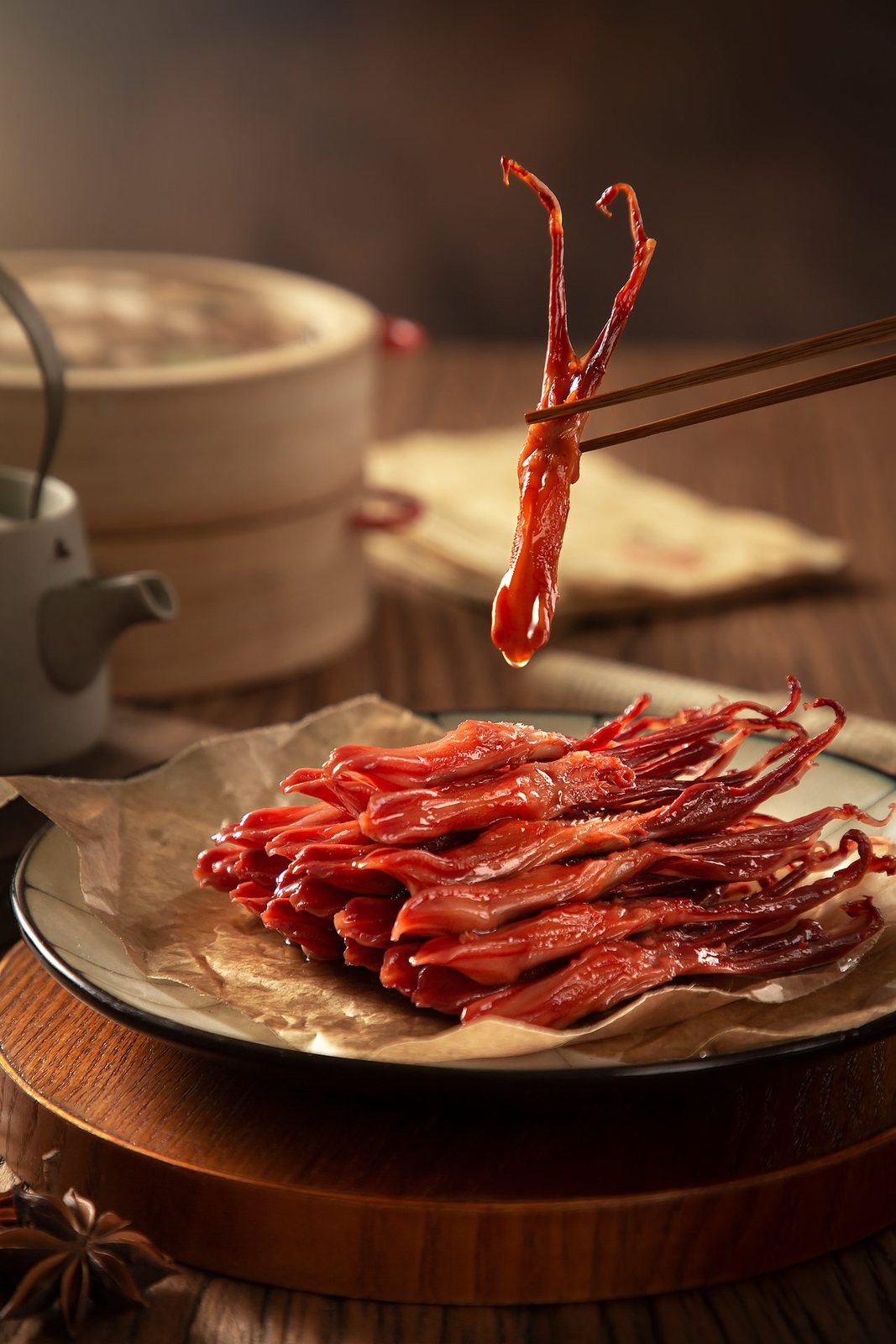
Wenzhou duck tongues, braised and stacked on oiled paper in a porcelain dish, one lifted by chopsticks
Image not loaded

Retry once you are online.

Wenzhou Duck TonguesFile photo

Onto Tables Further Away

The 10,000-Person Wenzhou Cuisine Banquet carried this table overseas, as described earlier. What makes the journey possible is people. Wenzhou people travel and trade far from home, and the taste of Wenzhou travels with them, becoming one marker of Chinese food abroad. The city is making it more systematic too: mapping the history and techniques of Wenzhou cuisine, and building a resource database for its food culture.

Whether a city's cuisine holds up in the end is not a question of how thick the recipe book is. It is a question of how many people are still willing to stand at the stove.

At seven the dishes go on the table. More often than not this table is not set for guests. It is set for family.

Sources4 items
  • The Zhongguo Ou Cai edited by Jin Cifan was published in 2002, ending the city's lack of a systematic recipe book. (《百余厨师研讨瓯菜技艺 追忆一代瓯菜宗师》, 16 August 2002)
  • The Zhongguo Ou Cai edited by Pan Xiaolin won a special contribution award at the 24th Gourmand World Cookbook Awards. (Report of 25 September 2025)
  • Zhou Xiong won the first national young-workers cooking competition in 1990, and later headed the China Ou Cuisine Research Institute and the Jinding culinary school. (《周雄:致力推广瓯菜的烹饪大师》, 10 December 2008 and 18 February 2009)
  • Xiang Zhaohui's Standardisation Manual for Wenzhou Cuisine Techniques is to break the craft of 67 traditional dishes into quantifiable data models. (Project-verified material)
Next watch · 19:00–21:00Xu · A Table Is a Gathering

Chapter 09 · Xu19:00–21:00

A Table Is a Gathering

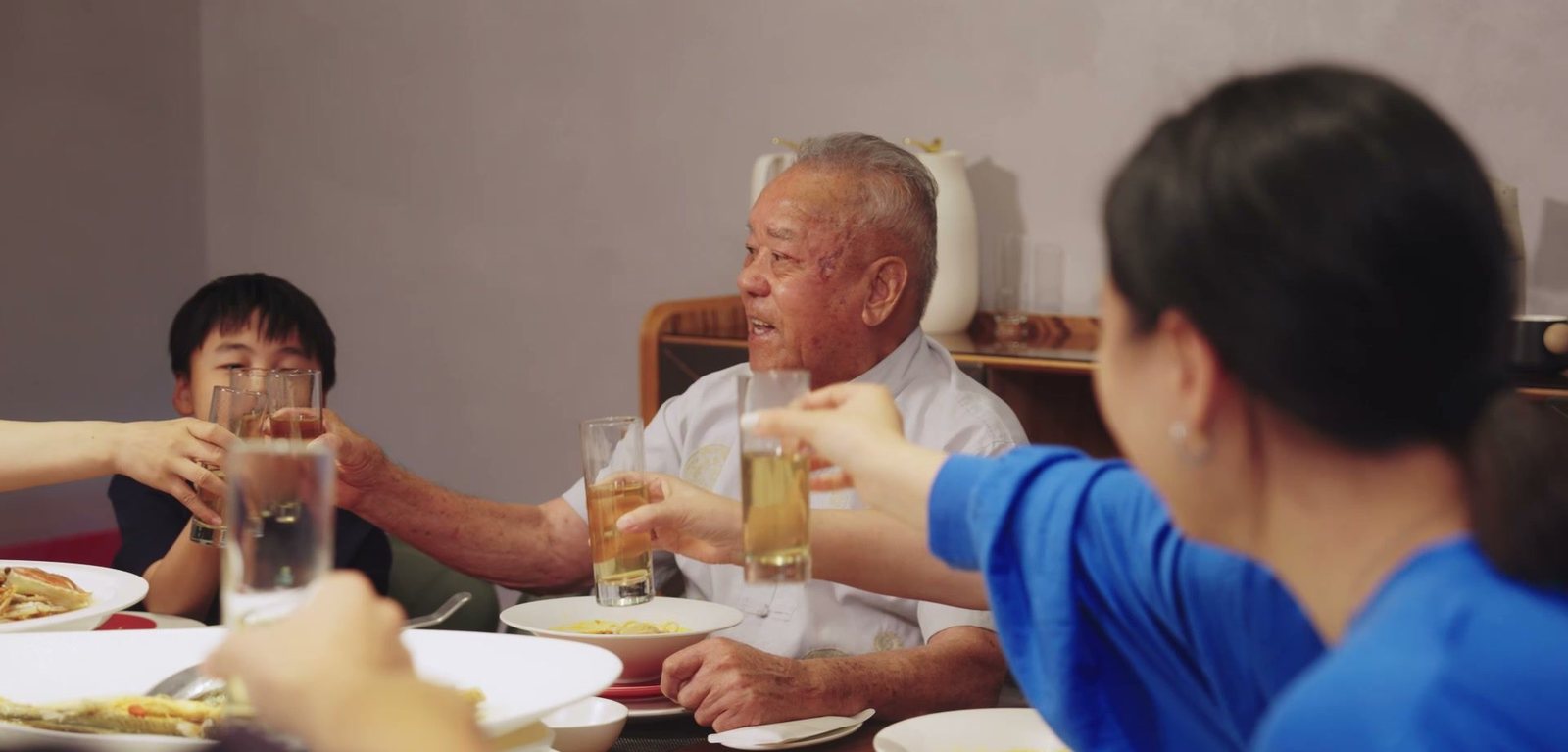
A family raising glasses at a home dinner, steamed fish and other dishes on the table
Image not loaded

Retry once you are online.

A toast at the family tableFile photo

At seven in the evening the round tables in Wenzhou homes start to fill.

Elsewhere the New Year's Eve meal is the *nianye fan*. In Wenzhou it is *Fensui Jiu* — the year-dividing feast. New Year's Eve is the line between one year and the next, and this meal draws it for the family. It begins with ten bowls.

Ten Red Bowls

Fensui Jiu opens with ten cold appetizers, each in a cinnabar-red footed bowl. Ten, for perfection in all things. Over each bowl goes a thin round slice of red radish, called "red vegetable". Red bowl with red vegetable, asking for a blazing year — a good omen.

What goes in the bowls varies by household, but the leads are always the same few: soy-sauce pork, soy-sauce chicken, dried eel, fish cake, duck tongue, blood clams, dried shrimp, fried hairtail, celery with pig's ear — plus a few seasonal fruits.

Ten hot courses follow, in a fixed order, like blessings called out one after another. The first is always fried rice cake, for rising year on year. Somewhere in the middle there is always a steamed fish with head and tail intact, for surplus year on year. The last is eight-treasure rice, for wealth rolling in.

This table is prepared from the start of winter. Once the eleventh lunar month comes, cured pork and dried eel are laid in. In the twelfth month every household dries soy-sauce chicken and pork, steams songgao and pounds rice cake. Fish cake is rushed at the last moment, and that one cold dish takes more work than any hot dish.

Wang Danxia, head of the Wenzhou Ou Cuisine Research Institute, remembers an earlier version. Before the mid-1980s the New Year's Eve meal opened with rice cake fried with rape shoots; braised pork was called "a good opening"; three-fresh soup stood for family happiness; and pounded fish soup, which Wenzhou people love, meant a bountiful year.

Eight Characters, Eight Wishes

Wenzhou people sum up a table of cold appetizers in eight characters: red, high, steady, whole, surplus, flower, luck, clear.

Put onto actual bowls, the eight characters are not at all mystical.

"High" is the plainest: the bowls are footed, and rice cake means rising year on year. "Surplus" is easy too. Wenzhou has a saying: without a good yellow croaker, a good year will not hold.

The rest work by sound and shape. In Wenzhou dialect "dried fish" sounds like "to think", so a child who eats it will use their head — also read as getting what you wish for. Fish cake is white inside and yellow out: gold and silver. A duck has only one tongue: one in a hundred. Dried shrimp come to the table head and tail on, hoping for things seen through from start to finish.

The convention can even leave the ingredients behind. A dough-figure artist has modeled dried eel, fish cake, soy-sauce chicken, soy-sauce pork, fried hairtail, pig's ear with celery and clams out of colored rice dough, added a plate of rice cake with rape shoots, and reproduced a whole Fensui Jiu table as an ornament.

Year after year of the same thing leaves its mark. One Mr Sun in the city has cooked the New Year's Eve meal himself for more than twenty years, the same dishes every time, and he no longer wants to touch soy-sauce pork or dried eel.

Every Table Has Its Own Reason

Fensui jiu is the banquet at home. A Wenzhou table takes other shapes too.

The "eight plates, eight" of Yongjiachang in Longwan is the highest courtesy there: eight cold appetizers, eight hot courses, eight people to a square table. The meaning is hidden in how the cold appetizers are laid out. The inner four sit at the center in a cross — rice cakes, boiled pork, dried eel, white shrimp, all farm produce. The outer four hold the corners — clams, dried cuttlefish, fish cake, smoked goose, all from fishing families. A cross at the center, four corners guarding it: land at one end, sea at the other, which is exactly how Yongjiachang lived, farming first and working the tide second.

The "imperial-scholar banquet" of Caocun in Rui'an is a banquet of examination success. Over two hundred years the village produced eighty-two imperial scholars. Its soul is a bowl of scholar's thin noodles, for passing the exam. Okra in scallion oil is "topping the list"; home-braised river crab is "the graduate in armour"; carp cooked with its scales is "the fish leaping the dragon gate". Eighteen dishes, every one with a meaning, and all of them made from ordinary country things.

The "hundred-family banquet" of Sankui in Taishun is the neighbors' banquet. It began with a meal of reconciliation: a quarrel within the Zhang clan of Zhangzhai village, and a family dinner after it was settled. Over the centuries the family dinner grew into a community dinner, and then into a festival for the whole town. Every Lantern Festival now, Sankui sets hundreds of tables along the street. The original logic has not changed: put people who might disagree on the same day, at the same table, and let them finish one meal.

The "Bowen Family Banquet" of Wencheng is a banquet made from a book. The menu comes from *Duo Neng Bi Shi*, a practical encyclopaedia written by Liu Bowen himself, with recipes tucked inside. "Three firsts in a row" is a mountain-starch dumpling; "two clean sleeves" is a plain bitter wild vegetable — commemorating the adviser who urged Zhu Yuanzhang towards thrift and uprightness. The man who wrote the book is the man being remembered.

The "ping'an banquet (peace banquet)" of Dongtou is a banquet for the goddess of the sea. On the twenty-third day of the third lunar month, Mazu's birthday, the lanes of Dongsha and Shajiao villages fill with more than a hundred tables carrying twelve courses of Mazu cuisine. A safe seafood rice asks for the whole family present; a whole steamed crab asks for a safe voyage; "gold and jade filling the hall" asks for a full hold at harvest.

Rui'an also has a Dragon Boat Banquet that did something no one else had: it moved half the tables out of the hotels and into village halls, seating villagers at menus designed by masters.

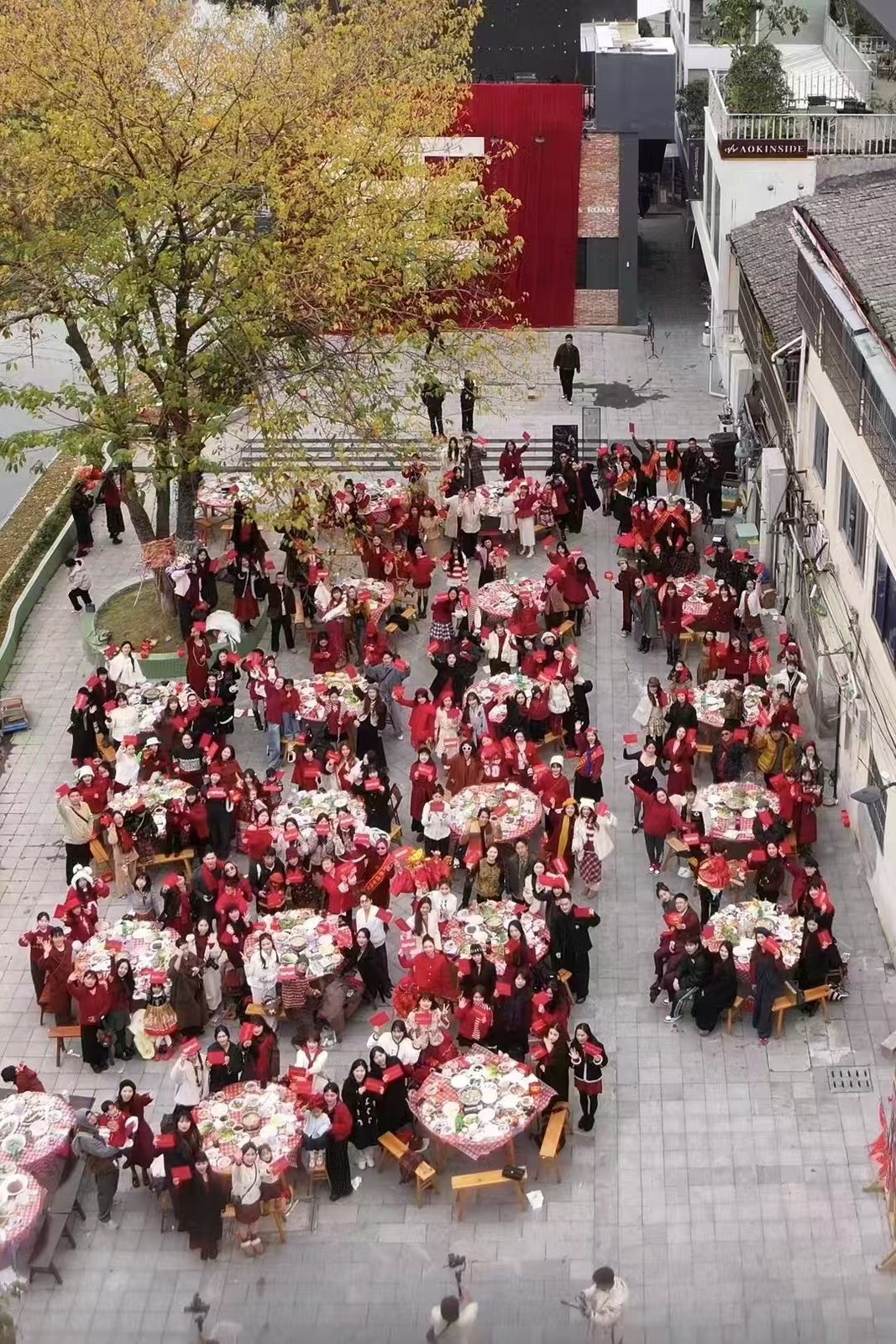
An outdoor communal meal: round tables set out, people gathered in red
Image not loaded

Retry once you are online.

Round tables in a villageFile photo

How to Sit, How to Reach

How to eat matters more than what.

The rules of "eight plates, eight" are set firmly. The table should be square, an eight-immortal table if possible. The honored sit at the top, the lesser at the bottom; elders at the top, the young at the bottom; the guest of honor at the top, accompanying guests at the bottom. When the meal opens, the host pushes the rice cake to the center — the plate never leaves the table, meaning farming is the root and the land is not left behind. Every time a hot dish arrives, the plates are pushed back into place. One chopstickful per round, only from the near side, eating from the outside in.

There is also a taboo. Yongjiachang sits by the sea and is rich in sea crab, yet these "ten-legged sea insects" never reach an "eight plates, eight" table. Locals regard them as kin to the dragon; leaving them off a banquet is a matter of respect for nature.

Whose Place Is Kept

Fensui jiu has one more rule, heavier than any dish.

The meal is eaten behind a closed door, and the door is opened afterwards: "doors shut, wealth made; doors open, good fortune". If someone in the family could not make it home, a seat is left empty for them with bowl and chopsticks laid out — "adding a person, adding a mouth". The chair may be empty. The person is not forgotten.

In 1950 a Wenzhou family invited the mayor to share Fensui Jiu at home. The ten footed red bowls held fried rice cake, braised pork, soy-sauce pork, fish cake and pounded fish. Sixty years later Daitou village in Longwan began "walk Daitou, eat a farmhouse Fensui Jiu", with villagers making rice cake, three-mix flour, plain noodles, sweet potato dates, spirits, smoked chicken and popcorn on the spot, and inviting outsiders to taste it all.

The mayor then, the villagers later — the same kind of table. The shape of a meal is the shape of whom a city is willing to count as its own.

The Fensui Jiu breaks up, the door opens, firecrackers go off. Wenzhou's tables are not only set at home. After nine, another set of tables is being put up on the street.

Sources3 items
  • The Sankui hundred-family banquet in Taishun set 600 tables for the 2026 Lantern Festival, drawing nearly 100,000 visits and more than 6 million yuan in spending. (Project-verified material)
  • The Dongtou Mazu rite was approved by the State Council in 2011 for the third batch of the national intangible cultural heritage list. (Project-verified material)
  • "Walk Daitou, eat a farmhouse Fensui Jiu" in Daitou village, Longwan, had three sections: making New Year goods, experiencing New Year customs, and tasting New Year flavors. (《走埭头,吃农家分岁酒》, 8 February 2010)
Next watch · 21:00–23:00Hai · Wenzhou at Night

Image note · No usable photographs yet of the ten cinnabar bowls of the New Year feast, the eight-by-eight seating, the Jinshi banquet or the Mazu safe-voyage feast. They are on the shooting list. The round-table image is a media-library file, not a photograph of those banquets.

Chapter 10 · Hai21:00–23:00

Wenzhou at Night

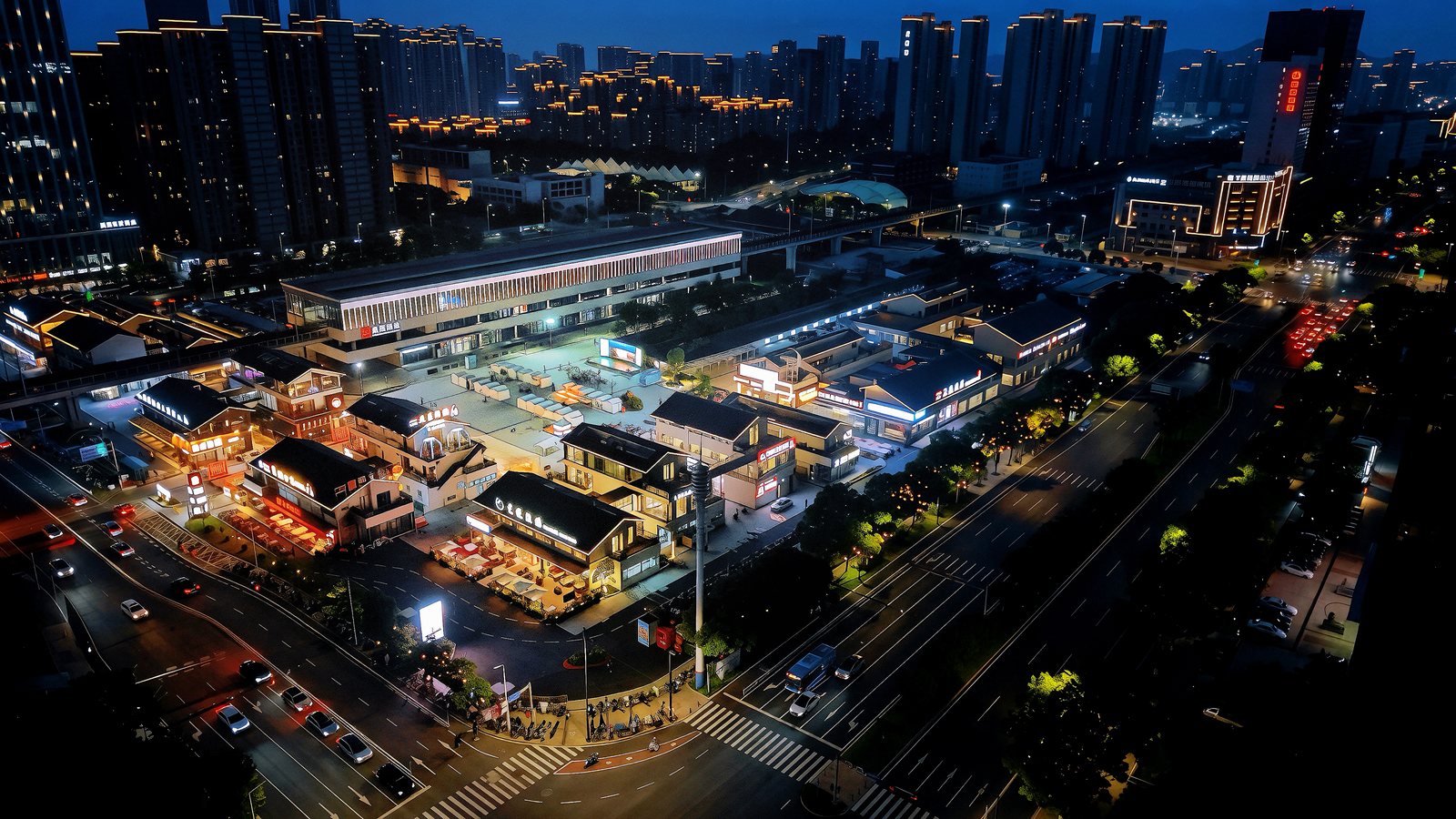
Aerial view of a commercial block at night: low food shops lit along the street, a rail station and high-rises behind, traffic moving
Image not loaded

Retry once you are online.

A city block at nightFile photo

At nine in the evening Wenzhou puts on another face.

Lights come up on both banks of the Ou River, and the moon sits on the water at Nantang. Local reporters have been writing this picture for more than a decade. Late-night food is the most solid layer beneath it.

Three Places, Three Kinds of Night

Wenzhou's night markets grew out of the cracks in the city.

One sits under a flyover, called Chengnan Wangshi, a new haunt for locals in recent years.

One is on a waterside old street, Wutian Old Street, which most visitors to Wenzhou end up seeing. Young people in hanfu crowd the stalls, a dengzhan gao in one hand and a bowl of almond jelly in the other. The woman selling fish ball soup puts it plainly: "On a summer night you have to fight for a seat by the river." Plenty of people finish the street and do not leave — they stay on purpose for the late-night food to start.

One is by a station exit, the Huimin night market. Dozens of stalls do seafood, barbecue and quick stir-fries, open from noon until the small hours.

One under a flyover, one by the water, one beside a station. Wenzhou has not gathered them onto a single food street. It lets each grow in its own ground. Whoever can walk there gets to eat.

What Gets Eaten at Night

The late-night menu walks the same road of freshness as the daytime.

The stars at a stall are local small seafood. Rice noodles fried with mud shrimp go down slippery and tender; razor clams in scallion oil are plump; big-head croaker steams into something that melts on entry. Sand crab, mud snails and small clams come to the table still carrying the smell of the sea.

A bowl of small-seafood noodles with crab, prawns, yellow croaker, clams and omelette strips in a clear broth
Image not loaded

Retry once you are online.

A bowl of small-seafood noodlesFile photo

Stalls have their own way of eating. Wenzhou people call one kind of small yellow croaker "croaker plum": split in half, fried golden, dipped in soy vinegar or salt and pepper, and torn apart by hand. Crisp outside, tender within.

Late-night eating in the 1980s and 1990s looked different again. An electric hotpot on every table, a special clear broth brought to the boil, a whole plate of raw chicken tipped in meat and feet together, and five minutes later you could start.

Some people only want congee at night. Salted-bone, swimming-crab, abalone and dried-scallop-with-chicken congee are all common. The fussier order swimming-crab congee or dried-scallop fish ball congee.

In recent years the headline dish has become crayfish. As soon as spring opens, the specialist seafood markets and branded restaurants get stock in before the produce markets do.

Raw-marinated seafood has also become popular, and one honest sentence belongs here: eating seafood raw carries real risk, and the spirits in the marinade cannot be relied on to kill pathogens. That is not a dampener. Understanding what you eat is part of the point.

How the Night Grew

Wenzhou's nightlife did not start in the last few years.

Twenty years ago Wenzhou raised the idea of "Night Wenzhou" and launched its first premium night-tour route, stringing together the best leisure spots in the center. Later, "Moonlit Nantang" became a signature night route.

The Xueshan Road, Jinhua Road and Huatan Lane area was a food cluster long ago. Local flavors like fish balls and Pingyang beef bone are here, and so are tastes from elsewhere.

Later the term "moonlight economy" entered local usage. Lucheng built around Nantang and Wuma Street, working three themes: night cruising on the Ou River, night entertainment by the Tang River, night shopping on Wuma Street.

Off the main line, a batch of fair-style night markets has come up: the Yanhuo market at Jiangnanli in Yangfushan, the beer and crayfish festival at Zhonggeng Manyou Tiandi, the Longhui night market, and the after-work market at Nantang Xintiandi.

The city began designating moonlight-economy clusters and demonstration sites, treating night-time spending as a serious part of building a regional consumption center.

From Moving to Settling

The night market really changed when the moving stalls got a fixed home.

The Tangtou night market in Oubei, Yongjia, was a roving internet-famous market before it settled. More than a hundred vendors moved in; two-wheeler bays were marked out on the pavement nearby and temporary parking was cleared opposite. That same year Longxia night market, the Sanyang night market food plaza and the Wutian Xinggu market opened one after another. By mid-year the city's commercial districts had more than ten night markets.

Alongside the bustle, someone handles the aftermath. Some night markets have contracts with cleaning companies to clear rubbish on a fixed schedule.

Footfall followed. Wutian Old Street started a music festival, the garden expo park built a light-and-shadow night tour, and Wutian's immersive night tour has stayed hot, drawing tens of thousands a day.

A good part of the heat comes from visitors. Tourists recommend Wenzhou food over and over on Xiaohongshu, Douyin and Weibo. A person in charge at the Wenzhou hotel and catering association sees it clearly: from Zibo barbecue to Tianshui malatang, local food has put cities on the trending list again and again.

Planning put up the stage for the night markets. What actually made them hot is one wave after another of people coming to eat.

The corner under a flyover, the flagstones of an old street, the row of stalls beside a station — together they are what this city looks like after dark. By day you eat freshness. By night you eat the smoke of daily life.

Just as the smoke begins to clear, more people are only now stepping out. At eleven, Wenzhou's day is not over. The latest bite belongs to the Zi hour.

Sources6 items
  • In 2006 Wenzhou proposed building the "Night Wenzhou" brand and its first premium night-tour route. (Report of 14 October 2014)
  • In 2019 the "nightlife index" rankings and the "moonlight economy" entered the local narrative; Wenzhou's nightlife index ranked second in the province. (《"夜生活指数"全省第二 温州"月光经济"如此迷人》, 24 August 2019)
  • Lucheng district built three night-time consumption platforms — night cruising on the Ou River, night entertainment by the Tang River, night shopping on Wuma Street — around the three elements of night touring, night eating and night shopping. (《首店经济、夜间经济、电商经济……鹿城区新型商贸模式提振消费》, 8 November 2022)
  • In 2023 the city's moonlight-economy clusters and demonstration sites were announced, following company applications, local review, expert assessment and public notice. (Report of 4 July 2023)
  • The Tangtou market in Oubei, Yongjia, settled in spring 2024 with more than 110 vendors; from April 2024 four night markets opened in succession, and by August the city's commercial districts had more than 10. (《城市烟火气回归!舌尖经济让夜温州"热辣滚烫"》, 17 July 2024; report of 20 August 2024)
  • The Wutian Old Street music festival drew more than 10,000 a day in 2025; in 2026 the garden expo park night tour and the Wutian Old Street immersive night tour drew more than 10,000 and 34,000 visits a day respectively. (《浙里夜生活多添一点料 浙江推出系列举措助燃夜间经济》, 3 August 2025; report of 1 September 2026)
Next watch · 23:00–01:00Zi · The Last Bite

Image note · No usable photographs yet of the three night markets — Chengnan Wangshi, Wutian Old Street and Huimin. (Night-market images in the library carry burned-in watermarks or prominent shop signs and were rejected.) They are on the shooting list. The chapter opener is a night aerial and the noodle image a media-library file; neither is a photograph of those markets.

Chapter 11 · Zi23:00–01:00

The Last Bite

Wenzhou big wontons in a blue-and-white bowl, a white spoon lifting one thin-skinned pork wonton, laver, dried shrimp and spring onion on the broth
Image not loaded

Retry once you are online.

A bowl of Wenzhou big wontonsFile photo

At eleven at night, Wenzhou is still awake.

In the lanes of the old town someone is still waiting for a bowl of wontons. A few years further back, you could hear a bamboo clapper at this hour.

A Phone Call at Midnight

One winter night twenty years ago, at one in the morning, someone called the Zhengyu fish ball shop for a delivery. Ten minutes later a bowl of fish ball noodles arrived. A good number of Wenzhou's old shops have stayed open all night on exactly this kind of trade.

Someone else, closing out a day of travel, wrote: "Back into the city at last — supper was Qiangneng fish balls."

Fish balls have earned the slot. In a hotel or a roadside shop, someone will always order a bowl. In the early 1990s Mr Huang, a fish ball maker, did something that counted as bold then: he swapped the cheap Spanish mackerel for the dearer mi-iuy croaker. Costs went up, and so, plainly, did the texture.

A Shop Carried on a Shoulder Pole

A wonton carrier is a shop on a shoulder pole. A stove and a pot at one end; a row of drawers at the other, this one for wrappers, that one for wontons already folded.

The hands fold too fast to follow. A wrapper in the right hand, laid on the left palm; a bamboo pick lifts a little minced pork from the tray and wipes it across the wrapper, left to right; a pinch, and it is done. The skin is thin enough to show the pink filling through it. Into the pot, and there is a rule outsiders do not know: the lid goes on, so the steam stays in and the wontons cook through.

What comes out is a plain bowl of pork wontons in clear broth, and the taste lasts. Someone local defined the night wonton trade in one line: it stops when you call, and you cannot count on finding it — a midnight canteen you come across rather than arrange.

Among the people who carried this pole is Xia Lili. His filling uses fresh pork tenderloin, mixed with cooking wine, seaweed and dried shrimp before folding. Not long ago the Wenzhou wonton carrier made it onto *A Bite of China*.

How far can a pole travel down the generations? One shopkeeper remembers his grandfather selling wontons at the mouth of Wuma Street. The carrier even crossed the strait. In Taiwan, China, there is not only a Wenzhou Street but Wenzhou-style big wontons.

Tok, Tok, Tok

The sound of the wonton carrier comes from a bamboo clapper.

After dark the carrier comes up the lane tapping it — tok, tok, tok — the sound drawing nearer, walking a flagstone street from one end to the other. Some say the clapper sounds warm: the stove is red, the wontons are fresh, the stomach is fed and the heart is caught with it.

Not long ago the sound turned up under a stage. *A Small Town's Story* was being sung on the old stage on Gongyuan Road, and the run of toks in the backing came from a wonton carrier below it. Many of the younger people in the audience had likely never seen a wonton carrier work a street. They remembered the sound.

The sound has been passed down; the carriers have thinned out. You still hear a bamboo clapper now and then, but few people carry the pole. A piece titled *The Wonton Carrier Without a Pole* noted that these days, even when you find one, it is usually a converted three-wheeled cart. The pole is gone. The feeling is not.

The afternoon belongs to the tok of a mallet on fish. After midnight it belongs to the tok of a bamboo clapper on a wonton cart. The same sound opens and closes a Wenzhou day.

The Rules Inside One Bowl

Wontons are ordinary food, common among ordinary people for more than a thousand years. Inside one bowl, though, every house keeps its own measure.

Someone earlier put the whole standard in one sentence: the skin thin, the salt right, the filling fresh lean pork. The toppings are fussier still — seaweed, shredded egg, pork floss, greens, wine-soaked dried shrimp, none of them optional. The broth has to be clear to the bottom. And one more detail: eight to a bowl, four large and four small.

The vendor pulls a drawer open, takes a bowl's worth and drops them into the pot. Seaweed and pickled mustard go on, then a little fermented bean curd and a few torn spinach leaves. Out of the pot, the wontons open in the bowl like flowers.

Wenzhou people sum up their own wontons in six words: thin skin, fragrant meat, generous toppings. The best-known sign is Tall Man Wontons (Changren Hundun). Chen Libiao came to Wenzhou from Yueqing and started with a single wonton stall. Nearly a century on, people still describe it the same way: thin skin and plenty of filling, rich toppings, clear broth and fresh taste. Wenzhou has several old signs like it.

Shops Still Lit at the Zi Hour

The wonton carrier is not the only thing lit at the Zi hour.

Xianqian Tangyuan on Gongyuan Road closed for two years, then reopened. The old snacks are still there — rice balls, wontons, glutinous rice breakfast — and a chef was brought in from Hangzhou to add braised dishes.

From that bowl of fish ball noodles twenty years ago to the wonton carrier that reached the screen, the pole became a three-wheeled cart and the clapper moved from the lane to the stage. At the Zi hour, Wenzhou is still lit. It is not written on a menu. It is written only in the doors that are still open.

Close to one, the late-night stalls begin to pack up. Another set of people are about to push the door open and go out.

Sources4 items
  • In early 2006 a reporter called the Zhengyu fish ball shop at 1 a.m. and had a bowl of fish ball noodles delivered ten minutes later. (《名牌老牌餐饮店通宵淘金 半夜一个电话叫来好吃的》, 22 January 2006)
  • Wenzhou night wontons appeared in season 4 of A Bite of China. (《〈舌尖上的中国〉为何选这碗深夜里的温州馄饨》, 13 February 2025; report of 10 February 2025)
  • Changren wontons date from around 1930; a 2016 report noted that Wenzhou has several long-established wonton shops. (16 April 2020; 《皮薄、肉香、料足 吃遍天下馄钝独爱温州这一口》, 10 July 2016)
  • The Xianqian Tangyuan shop on Gongyuan Road reopened in 2020 after two years closed. (《县前汤圆公园路店时隔两年重新营业》, 22 September 2020)
Next watch · 01:00–03:00Chou · A Day Ends, the Next Begins

Chapter 12 · Chou01:00–03:00

A Day Ends, the Next Begins

Panorama of Wenzhou where the Ou River crosses the city, lights coming on along both banks
Image not loaded

Retry once you are online.

The Ou River at nightFile photo

At one in the morning the late-night stalls close.

Past this hour only a handful of all-night old shops will still bring a bowl of noodles to your door. The lights of this shift go out one by one. Wenzhou has not gone to sleep. It has changed shifts.

The Last Shift Closes Here

The bowls are washed, the stove is damped down, the drawers of the wonton carrier are shut. This is the only genuinely quiet moment of the day.

The quiet lasts only an hour or two. The Chou hour is not the tail of the night. It is the seam between two days.

Thirty Gates for One Piece of Meat

The most orderly thing that happens in the Chou hour happens in a slaughterhouse.

Pork for the three districts of Lucheng, Longwan and Ouhai goes to one designated mechanized slaughterhouse. It supplies the city with more than 2,000 pigs a day.

From the pre-slaughter rinse of the trotters to the pork reaching the dispatch platform, one pig passes through thirty process steps. The plant was built for a more distant future, designed for 1.2 million head a year.

The rule is written into a document: pigs sold in the city must be slaughtered at the designated plant. Slaughtering elsewhere and selling is not allowed.

At Two O'Clock, the People Going to Market

The people going out in the Chou hour are not only workers on a line. They are also the ones going to choose stock.

A village chef who cooks banquets in people's homes gets up at two in the morning and drives to the Yongqiang seafood market. That day he had two New Year tables booked, and needed small abalone, salmon, crab and little yellow croaker.

An elderly man in Yueqing often sets out at two or three to buy the freshest little yellow croaker for his grandson, heading for Liushi central market.

At the turn of the year the line gets busier. Seafood processors start making dried goods and wholesalers start stockpiling. Among the people going to market in the Chou hour you cannot tell who is buying for their own household and who is buying for someone else's table. The only difference is how much.

Loaded Before Daylight

The wholesale market before dawn does not run on shouting. It runs on numbers.

Bayberry season makes the point best. In the years when overseas orders were heavy, wholesalers worked through the night almost every day. Ding'ao, Dongkui, Biqi, and Wandao came to market in turn. For a crate of bayberries to go abroad, someone has to pick it out in the small hours and load it onto a truck.

The all-nighter at the wholesale market is part of this city's exports too.

Waiting for the Morning Market

The last stretch of the Chou hour is spent waiting for the morning market to open.

The hundred-meter street market by Zhongshan Park on Gongyuan Road is remembered by Wenzhou people for many years. Banned repeatedly, it only got busier. Eventually the vendors lined up neatly along both sides of the road instead of crowding together. Later still, the market — open more than thirty years — moved as a whole into the Xingwenli produce market a few hundred meters away.

One junction to another. The hour the traders get up did not change.

The breakfast people get up earlier still. During the college entrance exams a school support worker got up just after four and hurried in to watch the pastry cook mix dough, and to arrange buns and wontons before the candidates arrived to eat a little after seven. A vendor at the garden expo park also starts prepping at four in the morning. Prep at four, open at seven — those three hours in between are handed over from the Chou hour.

The City Does Not Sleep at the Chou Hour

To say the Chou hour is quiet, there is evidence to the contrary.

Residents of Liuyuan community in Xialüpu complained that the Nantang Street rebuild site ran excavators at two or three in the morning for several days, loud enough to keep them awake. Someone else, remembering home, wrote: "each time I was woken before dawn by a tractor".

These are not pleasant sounds, but they show one thing: at the Chou hour in Wenzhou, machines and people are both moving. The noisy places are almost always markets and building sites — exactly where two shifts hand over.

Of the twelve watches, the Chou hour is the hardest to name. It is not the end of yesterday, nor the start of today.

The late-night stalls have closed and the slaughter line has started; the people picking stock have gone out and the morning market lights are on. For an hour or two there is hardly a diner anywhere — only the people handing a city's breakfast over to the next shift.

At three, the first truck of goods arrives. The Yin hour: the city starts to load.

Sources4 items
  • From 2006 the three districts of Lucheng, Longwan and Ouhai have used unified designated slaughter, supplying more than 2,000 pigs a day, designed for 1.2 million head a year, with a total investment of more than 50 million yuan on over 70 mu. (Report of 19 April 2006)
  • In 2007 the city economic and trade commission published the list of 50 designated pig slaughtering enterprises, including the Wenzhou Vegetable Basket livestock slaughter and processing company. (Report of 23 October 2007)
  • Wenzhou's bayberry acreage is 325,000 mu, worth 1.27 billion yuan; in 2023 overseas orders rose several-fold on previous years, above pre-pandemic levels. (《温州杨梅海外订单涨6倍 批发商最近几乎天天忙通宵》, 26 June 2023)
  • After more than 30 years the Gongyuan Road morning market completed its move into the Xingwenli produce market. (《公园路早市搬入新址今天开业》, 20 June 2019)
Next watch · 03:00–05:00Yin · The Fish Come In Before Daylight

Image note · The chapter opener is a panorama of the Ou River at dusk, not a scene from the small hours. Photographs of the slaughterhouse, the wholesale market and the morning market are still to come and are on the shooting list.

Wenzhou · A bid for the UNESCO Creative City of Gastronomy

A day ends, the next begins.

Wenzhou News Network · Sources and notes

The twelve chapters draw on publicly reported local coverage and material verified by the project. People, dates and figures come mainly from reports published by Wenzhou News Network; the source list is behind "View sources" in the footer. Figures are dated as noted; passages without a year are general background, not the latest statistics.

Images come from the project media library and do not correspond one-to-one to the scenes described.

Frequently asked6 questions
What is Twelve Watches, Understanding Wenzhou?
A special feature from the official site of Wenzhou's bid for the UNESCO Creative City of Gastronomy. It follows twelve two-hour watches through one day of eating in Wenzhou — twelve chapters of text and twenty-seven registered photographs, all drawn from the project's media library and logged by asset number.
What are the twelve watches, and what does each chapter cover?
Yin 03:00–05:00 The Fish Come In Before Daylight; Mao 05:00–07:00 Wenzhou Wakes; Chen 07:00–09:00 The First Bite of Wenzhou; Si 09:00–11:00 Where the Freshness Comes From; Wu 11:00–13:00 One Table of Wenzhou; Wei 13:00–15:00 Between Mountain and Sea; Shen 15:00–17:00 How a Dish Stays; You 17:00–19:00 Today's Wenzhou Cuisine; Xu 19:00–21:00 A Table Is a Gathering; Hai 21:00–23:00 Wenzhou at Night; Zi 23:00–01:00 The Last Bite; Chou 01:00–03:00 A Day Ends, the Next Begins.
What does tianguang mean in Wenzhou?
Tianguang, literally “daylight”, is the Wenzhou word for breakfast — the hour of the day standing in for the meal. Asked what he ate in the morning, a Wenzhou native will say he has had tianguang.
How do Wenzhou cuisine and Ou cuisine relate?
Wenzhou cuisine is also known as Ou cuisine, and is one of the four schools of Zhejiang cuisine. Wenzhou cuisine is the name used in public-facing material; Ou cuisine is kept for intangible-heritage, craft and local contexts, as in the Ou Cuisine Cooking Technique.
Where do the facts and figures come from?
They were compiled and checked by the City Time-Space Trusted Content Hub of the Wenzhou News Media Center, drawing on the historical newspaper archive and other public material, including original reports published by Wenzhou News Network between 2000 and 2026. Every source cited in the text can be checked item by item under “View sources” in the page footer.
Is Wenzhou already a UNESCO Creative City of Gastronomy?
Not yet. Wenzhou is bidding for the title, and this feature is published during the bid; it does not mean the title has been awarded. Six Chinese cities currently hold the UNESCO Creative Cities Network designation for gastronomy: Chengdu; Shunde; Macao, China; Yangzhou; Huai'an; and Chaozhou.

Published by

City Time-Space Trusted Content Hub

The history, dates and figures in this feature were compiled and checked by the City Time-Space Trusted Content Hub of the Wenzhou News Media Center, drawing on the historical newspaper archive and other public material, including original reports published by Wenzhou News Network between 2000 and 2026.

Produced by

Wenzhou News Media Center · Wenzhou News NetworkOfficial site of Wenzhou's bid for the UNESCO Creative City of Gastronomy

SOURCE TRACE

Source list

The twelve chapters cite 213 hub sources and 350 anchors, spanning 2002–2026 and drawn entirely from reports already published by Wenzhou News Network. 81 can be opened at the original page; the rest list number and date only; a further 5 carry hub placeholder dates.

Yin 03:00–05:00Chapter 1 · The Fish Come In Before Daylight24 sources · 46 anchors

  1. Hub asset 66wz:news:20051018:100012735Wenzhou News Network · 2005-10-18 · Historic report · available in the newspaper archive · cited 3 times
  2. Hub asset 66wz:news:20071103:100432414Wenzhou News Network · 2007-11-03 · Historic report · available in the newspaper archive · cited 2 times
  3. Hub asset 66wz:news:20130208:103534897Wenzhou News Network · 2013-02-08 · Historic report · available in the newspaper archive · cited 1 times
  4. Hub asset 66wz:news:20130304:103556868Wenzhou News Network · 2013-03-04 · Historic report · available in the newspaper archive · cited 1 times
  5. Hub asset 66wz:news:20141105:104265156Wenzhou News Network · 2014-11-05 · Original page no longer online · cited 1 times
  6. 浙江东日拎进“温州菜篮子” 菜价将会保持平稳Wenzhou News Network · 2015-06-05 · cited 2 times
  7. 锦绣农贸市场19日谢幕 现代冷链物流中心同日开业Wenzhou News Network · 2017-12-05 · cited 2 times
  8. 温州农批市场从此“菜场”变“商场”Wenzhou News Network · 2017-12-20 · cited 1 times
  9. 温州市水产批发市场蝤蛑全“松绑”Wenzhou News Network · 2018-03-17 · cited 1 times
  10. 市民餐桌上的海鲜哪里来?跟着船老大做回渔民Wenzhou News Network · 2018-08-07 · cited 2 times
  11. 记者中秋节前探“菜市” 螃蟹对虾交易增58%Wenzhou News Network · 2019-09-14 · cited 3 times
  12. 水产市场迁至现代冷链物流中心南区 规模扩大五倍Wenzhou News Network · 2020-01-16 · Original page no longer online · cited 1 times
  13. 水产批发交易迁新址 市场规模扩大5倍Wenzhou News Network · 2020-01-19 · cited 3 times
  14. 无人机消毒 现代冷链物流农批园区复市率98%以上Wenzhou News Network · 2020-03-12 · cited 1 times
  15. “二师兄”降价了 温州新增一家猪肉批发中心Wenzhou News Network · 2020-04-09 · cited 1 times
  16. 记者亲历进口冷链食品监管现场:层层把关,让冷链食品安全“越冬”Wenzhou News Network · 2020-12-08 · cited 1 times
  17. Hub asset 66wz:news:20240805:105647712Wenzhou News Network · 2024-08-05 · Original page no longer online · cited 4 times
  18. 市场多款蔬菜价格回归“白菜价” 市民菜篮子拎得更轻松了Wenzhou News Network · 2024-11-26 · cited 1 times
  19. 东海第一网“鲜”凌晨上市 海鲜价格走高冻品“腰斩”出货Wenzhou News Network · 2025-08-07 · cited 2 times
  20. 温州:冷链车背后的“世界美食之都”梦Wenzhou News Network · 2026-04-08 · cited 3 times
  21. 从东海到餐桌 一条鱼的“锁鲜”之旅Wenzhou News Network · 2026-06-24 · cited 4 times
  22. Hub asset 66wz:news:20260624:105793188Wenzhou News Network · 2026-06-24 · Original page no longer online · cited 3 times
  23. Hub asset 66wz:news:20260811:105820599Wenzhou News Network · 2026-08-11 · Original page no longer online · cited 2 times
  24. Hub asset 66wz:news:20260821:105825266Wenzhou News Network · 2026-08-21 · Original page no longer online · cited 1 times

Mao 05:00–07:00Chapter 2 · Wenzhou Wakes17 sources · 33 anchors

  1. 清晨养生一碗粥Wenzhou News Network · 2005-08-17 · Historic report · available in the newspaper archive · cited 3 times
  2. Hub asset 66wz:news:20070828:100387293Wenzhou News Network · 2007-08-28 · Historic report · available in the newspaper archive · cited 1 times
  3. 首个早餐行业标准出台 个体煎饼摊可能被取缔Wenzhou News Network · 2008-01-09 · Historic report · available in the newspaper archive · cited 1 times
  4. Hub asset 66wz:news:20080516:100549653Wenzhou News Network · 2008-05-16 · Historic report · available in the newspaper archive · cited 1 times
  5. [温州味道] 咸炊饭,甜豆浆Wenzhou News Network · 2008-07-07 · Historic report · available in the newspaper archive · cited 1 times
  6. 帮父母卖早点的小男孩Wenzhou News Network · 2008-09-08 · Historic report · available in the newspaper archive · cited 2 times
  7. 早安,早餐!Wenzhou News Network · 2009-03-30 · Historic report · available in the newspaper archive · cited 2 times
  8. 肯德基用豆浆粉泡豆浆 市民:早餐豆浆是粉泡的?Wenzhou News Network · 2011-08-01 · Historic report · available in the newspaper archive · cited 1 times
  9. 温州人的这些独特生活习惯 你中枪几个?Wenzhou News Network · 2015-12-16 · cited 2 times
  10. 现代菜篮子开出首家农贸邻里中心 除了买菜还能逛超市买药护理牙齿Wenzhou News Network · 2019-05-03 · cited 1 times
  11. 走,到“三姐妹”家做客去!听听她们如何通过糯米饭实现人生逆袭Wenzhou News Network · 2020-07-13 · cited 2 times
  12. 一朝一食,一起来品尝清晨的第一口温州味道Wenzhou News Network · 2020-10-30 · cited 3 times
  13. Hub asset 66wz:news:20230413:105561187Wenzhou News Network · 2023-04-13 · Original page no longer online · cited 1 times
  14. 消费红包里“藏”着温州连锁隐形冠军Wenzhou News Network · 2023-04-13 · cited 3 times
  15. Hub asset 66wz:news:20231003:105602733Wenzhou News Network · 2023-10-03 · Original page no longer online · cited 2 times
  16. 你的“天光”吃什么Wenzhou News Network · 2024-06-27 · cited 5 times
  17. Hub asset 66wz:news:20260814:105822432Wenzhou News Network · 2026-08-14 · Original page no longer online · cited 2 times

Chen 07:00–09:00Chapter 3 · The First Bite of Wenzhou9 sources · 21 anchors

  1. 不能成为过去的猪脏粉Wenzhou News Network · 2007-08-12 · Historic report · available in the newspaper archive · cited 2 times
  2. [温州味道] 咸炊饭,甜豆浆Wenzhou News Network · 2008-07-07 · Historic report · available in the newspaper archive · cited 1 times
  3. 三姐妹:炊饭店的故事Wenzhou News Network · 2009-08-31 · Historic report · available in the newspaper archive · cited 4 times
  4. 鱼丸鸭舌猪脏粉 来温州旅游这些小吃不可错过Wenzhou News Network · 2016-04-05 · cited 2 times
  5. 第一瓶温州产的啤酒诞生在哪里?这本书可以告诉你Wenzhou News Network · 2019-06-26 · cited 1 times
  6. 入冬就要捧在手心里暖暖的幸福!这些温州经典美食,分享给你Wenzhou News Network · 2021-12-28 · cited 1 times
  7. 猪脏粉,才是深夜里的一碗“回魂汤”!Wenzhou News Network · 2022-02-27 · cited 1 times
  8. 你的“天光”吃什么Wenzhou News Network · 2024-06-27 · cited 2 times
  9. 一碗糯米饭,滋养百味人生Wenzhou News Network · 2024-07-23 · cited 7 times

Plus 7 local editorial sources (小吃温州糯米饭.doc), existing drafts in the project workspace, not hub assets.

Si 09:00–11:00Chapter 4 · Where the Freshness Comes From34 sources · 41 anchors

  1. Hub asset 66wz:news:20040803:057268834Wenzhou News Network · 2004-08-03 · Historic report · available in the newspaper archive · cited 1 times
  2. Hub asset 66wz:news:20061107:100208699Wenzhou News Network · 2006-11-07 · Historic report · available in the newspaper archive · cited 1 times
  3. Hub asset 66wz:news:20080711:100582636Wenzhou News Network · 2008-07-11 · Historic report · available in the newspaper archive · cited 1 times
  4. 永嘉获中国田鱼之乡金名片 全县稻田养鱼8万多亩Wenzhou News Network · 2008-09-01 · Historic report · available in the newspaper archive · cited 2 times
  5. 下寮高山本地鸡Wenzhou News Network · 2010-01-19 · Historic report · available in the newspaper archive · cited 2 times
  6. 洞头首届羊栖菜节 我来做回赶海姑娘(组图)Wenzhou News Network · 2013-05-20 · Historic report · available in the newspaper archive · cited 1 times
  7. Hub asset 66wz:news:20130703:103711625Wenzhou News Network · 2013-07-03 · Historic report · available in the newspaper archive · cited 1 times
  8. 现代农业园区拍摄范围名单Wenzhou News Network · 2015-11-05 · cited 2 times
  9. 3天6万多人次逛温州农博会 市民投票选出“十大品牌农产品”Wenzhou News Network · 2018-11-14 · cited 1 times
  10. “海洋日”浙江主场活动青睐洞头Wenzhou News Network · 2019-06-07 · cited 1 times
  11. 他把辽宁刺参养在苍南老家 把老家海参卖到全国各地Wenzhou News Network · 2019-07-26 · cited 2 times
  12. Hub asset 66wz:news:20191219:105218356Wenzhou News Network · 2019-12-19 · Original page no longer online · cited 1 times
  13. Hub asset 66wz:news:20210209:105345760Wenzhou News Network · 2021-02-09 · Original page no longer online · cited 1 times
  14. 洞头“两菜一鱼”全部获得国字号金名片Wenzhou News Network · 2021-03-18 · cited 1 times
  15. 鹿城区藤桥镇入选2021年国家农业产业强镇 藤桥借“鸡”振翅腾飞Wenzhou News Network · 2021-04-09 · cited 1 times
  16. 好吃!温州这一美食商标,国家认证Wenzhou News Network · 2021-10-12 · cited 1 times
  17. 镶嵌于山海深处,这些温州宝藏小镇,是该找个时间好好逛逛了~~Wenzhou News Network · 2021-10-31 · cited 1 times
  18. 省特色农产品优势区名单公布 温州又有三大特色上榜Wenzhou News Network · 2021-11-16 · cited 1 times
  19. Hub asset 66wz:news:20220127:105435991Wenzhou News Network · 2022-01-27 · Original page no longer online · cited 1 times
  20. 嫁接预制菜 “温州味”加速走向全世界Wenzhou News Network · 2022-05-13 · cited 2 times
  21. 一只三黄鸡 “定义”一个镇Wenzhou News Network · 2022-09-23 · cited 1 times
  22. Hub asset 66wz:news:20230330:105557691Wenzhou News Network · 2023-03-30 · Original page no longer online · cited 1 times
  23. 安排上!夜游+滨海,带你感受不一样的苍南Wenzhou News Network · 2023-04-30 · cited 1 times
  24. 乐清:一株“仙草”富一方 石斛花儿再开悬崖Wenzhou News Network · 2023-05-24 · cited 1 times
  25. Hub asset 66wz:news:20230727:105590606Wenzhou News Network · 2023-07-27 · Original page no longer online · cited 1 times
  26. 真・电影取景地!“吹过你吹过的风”,这座浙南小城夏日封神!Wenzhou News Network · 2023-07-31 · cited 1 times
  27. 2023中国霞关虾皮节开幕 共谋虾皮业发展Wenzhou News Network · 2023-11-18 · cited 2 times
  28. 点亮乡村过大年 温州农产品迎新春大联展开幕Wenzhou News Network · 2024-01-20 · cited 1 times
  29. Hub asset 66wz:news:20240424:105632094Wenzhou News Network · 2024-04-24 · Original page no longer online · cited 2 times
  30. 五一来苍南霞关体验簪花,感受浪漫与美Wenzhou News Network · 2024-05-02 · cited 1 times
  31. “村BA”里的山海味Wenzhou News Network · 2024-07-25 · cited 1 times
  32. Hub asset 66wz:news:20240811:105648526Wenzhou News Network · 2024-08-11 · Original page no longer online · cited 1 times
  33. Hub asset 66wz:news:20260710:105801568Wenzhou News Network · 2026-07-10 · Original page no longer online · cited 1 times
  34. Hub asset 66wz:news:20260820:105824993Wenzhou News Network · 2026-08-20 · Original page no longer online · cited 1 times

Plus 3 local editorial sources (热菜石斛老鸭煲.docx#para4), existing drafts in the project workspace, not hub assets.

Wu 11:00–13:00Chapter 5 · One Table of Wenzhou14 sources · 22 anchors

  1. Hub asset 66wz:news:19700101:105782556Wenzhou News Network · date and URL are hub placeholders; not located · cited 2 times
  2. Hub asset 66wz:news:20111014:102812805Wenzhou News Network · 2011-10-14 · Historic report · available in the newspaper archive · cited 1 times
  3. Hub asset 66wz:news:20121026:103409754Wenzhou News Network · 2012-10-26 · Historic report · available in the newspaper archive · cited 1 times
  4. Hub asset 66wz:news:20121225:103482630Wenzhou News Network · 2012-12-25 · Historic report · available in the newspaper archive · cited 1 times
  5. Hub asset 66wz:news:20151214:104661561Wenzhou News Network · 2015-12-14 · Original page no longer online · cited 2 times
  6. 万人瓯菜宴冷盘热菜有讲究 名厨讲述菜单出炉始末Wenzhou News Network · 2015-12-28 · cited 6 times
  7. Hub asset 66wz:news:20201027:105320219Wenzhou News Network · 2020-10-27 · Original page no longer online · cited 1 times
  8. 网络中国节|从年夜饭,看“食”代变迁Wenzhou News Network · 2022-01-30 · cited 1 times
  9. 一尾鱼的情结Wenzhou News Network · 2022-12-01 · cited 1 times
  10. Hub asset 66wz:news:20230329:105557417Wenzhou News Network · 2023-03-29 · Original page no longer online · cited 1 times
  11. 【温网观察】潘平平:让千年瓯菜谱写新时代篇章Wenzhou News Network · 2024-01-22 · cited 1 times
  12. 瓯菜天下鲜!世界瓯菜万人宴开宴Wenzhou News Network · 2024-01-27 · cited 2 times
  13. “温州配”中的黄金配角Wenzhou News Network · 2024-10-29 · cited 1 times
  14. Hub asset 66wz:news:20260901:105831411Wenzhou News Network · 2026-09-01 · Original page no longer online · cited 1 times

Plus 4 local editorial sources (58_瓯菜十大代表菜和十大小吃_技艺与市井的两副面孔.html), existing drafts in the project workspace, not hub assets.

Wei 13:00–15:00Chapter 6 · Between Mountain and Sea28 sources · 31 anchors

  1. Hub asset 66wz:news:19700101:105710001Wenzhou News Network · date and URL are hub placeholders; not located · cited 1 times
  2. Hub asset 66wz:news:20040729:057041418Wenzhou News Network · 2004-07-29 · Historic report · available in the newspaper archive · cited 1 times
  3. Hub asset 66wz:news:20040826:058440363Wenzhou News Network · 2004-08-26 · Historic report · available in the newspaper archive · cited 1 times
  4. 南麂大黄鱼领“护照” 原产地保护产品又添新丁Wenzhou News Network · 2005-07-16 · Historic report · available in the newspaper archive · cited 1 times
  5. 2016还剩三分之一 赶紧看看温州还有哪里好玩Wenzhou News Network · 2016-09-20 · cited 1 times
  6. “小雪”驾到,三垟瓯柑开摘Wenzhou News Network · 2019-11-22 · cited 1 times
  7. Hub asset 66wz:news:20200102:105221776Wenzhou News Network · 2020-01-02 · Original page no longer online · cited 1 times
  8. 温州人年夜饭“最硬”菜!这样烧才好吃Wenzhou News Network · 2021-02-11 · cited 1 times
  9. Hub asset 66wz:news:20210430:105364383Wenzhou News Network · 2021-04-30 · Original page no longer online · cited 1 times
  10. Hub asset 66wz:news:20211207:105423008Wenzhou News Network · 2021-12-07 · Original page no longer online · cited 1 times
  11. 大黄鱼用上声波围栏 国内首个无网海洋牧场落户洞头Wenzhou News Network · 2022-12-21 · cited 1 times
  12. 从温州出发 共赴一场“海丝”之约Wenzhou News Network · 2023-02-18 · cited 1 times
  13. 人民网:温州市洞头区渔港经济区入选国家级试点名单Wenzhou News Network · 2023-04-20 · cited 2 times
  14. 永嘉县荣获浙江省实施乡村振兴战略实绩考核优秀单位Wenzhou News Network · 2024-04-07 · cited 1 times
  15. 温州这座以港口命名的城市,入围国家级渔港经济区Wenzhou News Network · 2024-05-21 · cited 2 times
  16. Hub asset 66wz:news:20240924:105654553Wenzhou News Network · 2024-09-24 · Original page no longer online · cited 1 times
  17. Hub asset 66wz:news:20250422:105681683Wenzhou News Network · 2025-04-22 · Original page no longer online · cited 1 times
  18. 引领省农博会新潮流!温州“六个一”绽放新“食”尚Wenzhou News Network · 2025-11-26 · cited 1 times
  19. Hub asset 66wz:news:20251127:105710769Wenzhou News Network · 2025-11-27 · Original page no longer online · cited 1 times
  20. 一场跨越时光的双向奔赴,朔门古港周边80名住户成为首批体验官Wenzhou News Network · 2026-04-11 · cited 1 times
  21. 一艘福船,从古港到园博Wenzhou News Network · 2026-04-16 · cited 2 times
  22. 从浅海到深海 一条鱼的“野化”之旅Wenzhou News Network · 2026-06-17 · cited 1 times
  23. Hub asset 66wz:news:20260706:66Wenzhou News Network · 2026-07-06 · Original page no longer online · cited 1 times
  24. Hub asset 66wz:news:20260710:105802137Wenzhou News Network · 2026-07-10 · Original page no longer online · cited 1 times
  25. Hub asset 66wz:news:20260720:105807991Wenzhou News Network · 2026-07-20 · Original page no longer online · cited 1 times
  26. Hub asset 66wz:news:20260722:105808940Wenzhou News Network · 2026-07-22 · Original page no longer online · cited 1 times
  27. Hub asset 66wz:news:20260801:105814878Wenzhou News Network · 2026-08-01 · Original page no longer online · cited 1 times
  28. Hub asset 66wz:news:20260901:105831407Wenzhou News Network · 2026-09-01 · Original page no longer online · cited 1 times

Plus 2 local editorial sources (55_渔港的一天_从潮汐到餐桌.html#para6), existing drafts in the project workspace, not hub assets.

Shen 15:00–17:00Chapter 7 · How a Dish Stays12 sources · 20 anchors

  1. 温州敲鱼Wenzhou News Network · 2008-05-07 · Historic report · available in the newspaper archive · cited 5 times
  2. 温州海鲜美食之敲鱼Wenzhou News Network · 2008-06-27 · Historic report · available in the newspaper archive · cited 4 times
  3. Hub asset 66wz:news:20101014:102122133Wenzhou News Network · 2010-10-14 · Historic report · available in the newspaper archive · cited 1 times
  4. Hub asset 66wz:news:20101108:102183206Wenzhou News Network · 2010-11-08 · Historic report · available in the newspaper archive · cited 1 times
  5. Hub asset 66wz:news:20111014:102812805Wenzhou News Network · 2011-10-14 · Historic report · available in the newspaper archive · cited 1 times
  6. 元旦举办健康时尚博览会 瓯菜瓯绣同台竞秀Wenzhou News Network · 2015-12-29 · cited 1 times
  7. 独属温州人的记忆 中国烹饪大师解读瓯菜文化Wenzhou News Network · 2016-01-12 · cited 1 times
  8. 温州厨星比拼“瓯菜技艺” 2017年全市烹饪大赛明日开锣Wenzhou News Network · 2017-10-10 · Original page no longer online · cited 1 times
  9. 林斤澜“矮凳桥”里的温州Wenzhou News Network · 2024-01-29 · cited 1 times
  10. Hub asset 66wz:news:20260713:105804286Wenzhou News Network · 2026-07-13 · Original page no longer online · cited 1 times
  11. 温州48人入选第七批省级非遗代表性传承人!居全省第二Wenzhou News Network · 2026-07-14 · Original page no longer online · cited 1 times
  12. Hub asset 66wz:news:20260901:105831411Wenzhou News Network · 2026-09-01 · Original page no longer online · cited 2 times

Plus 4 local editorial sources (81_非遗技艺_温州传统烹饪与食品制作非遗.html#para1), existing drafts in the project workspace, not hub assets.

You 17:00–19:00Chapter 8 · Today's Wenzhou Cuisine6 sources · 6 anchors

  1. 百余厨师研讨瓯菜技艺 追忆一代瓯菜宗师Wenzhou News Network · 2002-08-16 · Historic report · available in the newspaper archive · cited 1 times
  2. 周雄:致力推广瓯菜的烹饪大师Wenzhou News Network · 2008-12-10 · Historic report · available in the newspaper archive · cited 1 times
  3. 周雄:致力推广瓯菜的烹饪大师Wenzhou News Network · 2009-02-18 · Historic report · available in the newspaper archive · cited 1 times
  4. 烹饪大师首创新瓯菜Wenzhou News Network · 2009-05-14 · Historic report · available in the newspaper archive · cited 1 times
  5. 做菜做人皆火候——访瓯菜大师潘晓林Wenzhou News Network · 2022-05-19 · Original page no longer online · cited 1 times
  6. 主编的《中国瓯菜》获两项大奖 温州瓯菜大师披国旗领奖Wenzhou News Network · 2025-09-25 · Original page no longer online · cited 1 times

Plus 1 local editorial sources (10_项朝晖_从灶台到讲台的工匠劳模.html#para1), existing drafts in the project workspace, not hub assets.

Xu 19:00–21:00Chapter 9 · A Table Is a Gathering11 sources · 17 anchors

  1. Hub asset 66wz:news:19700101:105487398Wenzhou News Network · date and URL are hub placeholders; not located · cited 1 times
  2. Hub asset 66wz:news:20041017:059122355Wenzhou News Network · 2004-10-17 · Historic report · available in the newspaper archive · cited 1 times
  3. Hub asset 66wz:news:20070217:100260101Wenzhou News Network · 2007-02-17 · Historic report · available in the newspaper archive · cited 1 times
  4. 走埭头,吃农家分岁酒Wenzhou News Network · 2010-02-08 · Historic report · available in the newspaper archive · cited 1 times
  5. Hub asset 66wz:news:20100226:101719889Wenzhou News Network · 2010-02-26 · Historic report · available in the newspaper archive · cited 1 times
  6. 年夜饭复古潮:高脚碗重回百姓家Wenzhou News Network · 2013-02-06 · Historic report · available in the newspaper archive · cited 2 times
  7. 温州分岁酒:冷盘热菜各十 高脚碗上桌炒年糕开席Wenzhou News Network · 2016-02-04 · cited 3 times
  8. 温州市区孙老伯坚持自烧年夜饭20余年 年味十足Wenzhou News Network · 2017-01-26 · cited 2 times
  9. 记忆中的温州味 从有仪式感的年夜饭开始Wenzhou News Network · 2018-02-07 · cited 1 times
  10. Hub asset 66wz:news:20230122:105539270Wenzhou News Network · 2023-01-22 · Original page no longer online · cited 2 times
  11. 年味,是装在红色高脚碗里的老底子过年饭Wenzhou News Network · 2023-01-29 · cited 2 times

Plus 8 local editorial sources (60_分岁酒家宴_用十只朱砂碗办的年度仪式.html), existing drafts in the project workspace, not hub assets.

Hai 21:00–23:00Chapter 10 · Wenzhou at Night21 sources · 35 anchors

  1. 夜宵 愈夜愈美味Wenzhou News Network · 2008-05-07 · Historic report · available in the newspaper archive · cited 1 times
  2. Hub asset 66wz:news:20091005:101453052Wenzhou News Network · 2009-10-05 · Historic report · available in the newspaper archive · cited 1 times
  3. 大排档 吃感觉Wenzhou News Network · 2010-08-31 · Historic report · available in the newspaper archive · cited 1 times
  4. 台湾士林夜市尚未落地 已兴起夜市热Wenzhou News Network · 2013-08-05 · Historic report · available in the newspaper archive · cited 1 times
  5. 月光经济来袭 温州绘璀璨夜色挖掘新经济Wenzhou News Network · 2014-10-14 · cited 3 times
  6. 温州那些忍不住想吃的夜宵 你都吃过哪几家?Wenzhou News Network · 2016-05-05 · Original page no longer online · cited 2 times
  7. “夜生活指数”全省第二 温州“月光经济”如此迷人Wenzhou News Network · 2019-08-24 · cited 1 times
  8. Hub asset 66wz:news:20220721:105487252Wenzhou News Network · 2022-07-21 · Original page no longer online · cited 1 times
  9. 首店经济、夜间经济、电商经济……鹿城区新型商贸模式提振消费Wenzhou News Network · 2022-11-08 · Original page no longer online · cited 1 times
  10. 月光经济消费新场景全域拓展 鼓励商家在夜间特定时段开展“外摆位”Wenzhou News Network · 2023-07-04 · cited 2 times
  11. 温州网红流动夜市“安家”了!Wenzhou News Network · 2024-04-22 · Original page no longer online · cited 1 times
  12. 城市烟火气回归!舌尖经济让夜温州“热辣滚烫”Wenzhou News Network · 2024-07-17 · cited 2 times
  13. 城市烟火气回归!舌尖经济让夜温州“热辣滚烫”Wenzhou News Network · 2024-07-17 · Original page no longer online · cited 4 times
  14. 夜宵怎么吃才更健康Wenzhou News Network · 2024-08-19 · Original page no longer online · cited 2 times
  15. Hub asset 66wz:news:20240820:105649648Wenzhou News Network · 2024-08-20 · Original page no longer online · cited 2 times
  16. Hub asset 66wz:news:20240925:105654775Wenzhou News Network · 2024-09-25 · Original page no longer online · cited 1 times
  17. 温州“夜宵顶流”小龙虾,抢“鲜”上市!Wenzhou News Network · 2025-03-05 · Original page no longer online · cited 1 times
  18. 浙里夜生活多添一点料 浙江推出系列举措助燃夜间经济Wenzhou News Network · 2025-08-03 · cited 1 times
  19. Hub asset 66wz:news:20260803:105815728Wenzhou News Network · 2026-08-03 · Original page no longer online · cited 5 times
  20. 温州夜生活 越夜越鲜活Wenzhou News Network · 2026-08-04 · Original page no longer online · cited 1 times
  21. Hub asset 66wz:news:20260901:105831512Wenzhou News Network · 2026-09-01 · Original page no longer online · cited 1 times

Zi 23:00–01:00Chapter 11 · The Last Bite19 sources · 47 anchors

  1. Hub asset 66wz:news:19700101:104908152Wenzhou News Network · date and URL are hub placeholders; not located · cited 2 times
  2. Hub asset 66wz:news:19700101:105776420Wenzhou News Network · date and URL are hub placeholders; not located · cited 3 times
  3. 名牌老牌餐饮店通宵淘金 半夜一个电话叫来好吃的Wenzhou News Network · 2006-01-22 · Historic report · available in the newspaper archive · cited 2 times
  4. Hub asset 66wz:news:20060607:100129664Wenzhou News Network · 2006-06-07 · Historic report · available in the newspaper archive · cited 2 times
  5. Hub asset 66wz:news:20060708:100146399Wenzhou News Network · 2006-07-08 · Historic report · available in the newspaper archive · cited 3 times
  6. Hub asset 66wz:news:20070303:100265247Wenzhou News Network · 2007-03-03 · Historic report · available in the newspaper archive · cited 1 times
  7. 天津馆的光面Wenzhou News Network · 2008-11-26 · Historic report · available in the newspaper archive · cited 2 times
  8. 天津馆Wenzhou News Network · 2009-03-18 · Historic report · available in the newspaper archive · cited 1 times
  9. Hub asset 66wz:news:20090329:101179335Wenzhou News Network · 2009-03-29 · Historic report · available in the newspaper archive · cited 4 times
  10. Hub asset 66wz:news:20100316:101755676Wenzhou News Network · 2010-03-16 · Historic report · available in the newspaper archive · cited 2 times
  11. Hub asset 66wz:news:20100830:102053500Wenzhou News Network · 2010-08-30 · Historic report · available in the newspaper archive · cited 2 times
  12. 寻觅温州街头的那些草根小馆(组图)Wenzhou News Network · 2013-01-31 · Historic report · available in the newspaper archive · cited 2 times
  13. 皮薄、肉香、料足 吃遍天下馄钝独爱温州这一口Wenzhou News Network · 2016-07-10 · cited 4 times
  14. 温州最有名的“大街”原来在这里!Wenzhou News Network · 2020-04-16 · cited 2 times
  15. 县前汤圆公园路店时隔两年重新营业Wenzhou News Network · 2020-09-22 · Original page no longer online · cited 2 times
  16. 深夜排队只为这一碗!温州敲馄饨暖心亮相《舌尖上的中国4》Wenzhou News Network · 2025-02-10 · Original page no longer online · cited 4 times
  17. 《舌尖上的中国》为何选这碗深夜里的温州馄饨Wenzhou News Network · 2025-02-13 · cited 6 times
  18. 每天送出600碗面,温州这家公益面馆提供“免费的午餐”Wenzhou News Network · 2025-07-25 · cited 1 times
  19. 一座传统戏台,不再“端着”了Wenzhou News Network · 2026-06-27 · cited 2 times

Chou 01:00–03:00Chapter 12 · A Day Ends, the Next Begins18 sources · 31 anchors

  1. 凌晨叫外卖有求必应吗?Wenzhou News Network · 2006-04-07 · Historic report · available in the newspaper archive · cited 1 times
  2. Hub asset 66wz:news:20060419:100103806Wenzhou News Network · 2006-04-19 · Historic report · available in the newspaper archive · cited 6 times
  3. Hub asset 66wz:news:20060515:100115984Wenzhou News Network · 2006-05-15 · Historic report · available in the newspaper archive · cited 1 times
  4. 凌晨挖土 噪音扰民Wenzhou News Network · 2006-09-06 · Historic report · available in the newspaper archive · cited 1 times
  5. Hub asset 66wz:news:20071023:100424417Wenzhou News Network · 2007-10-23 · Historic report · available in the newspaper archive · cited 1 times
  6. 公园路早市,利益在作祟Wenzhou News Network · 2008-07-28 · Historic report · available in the newspaper archive · cited 1 times
  7. Hub asset 66wz:news:20081112:100911094Wenzhou News Network · 2008-11-12 · Historic report · available in the newspaper archive · cited 3 times
  8. 公园路早市告别“脏乱差”Wenzhou News Network · 2009-01-14 · Historic report · available in the newspaper archive · cited 1 times
  9. Hub asset 66wz:news:20090406:101184596Wenzhou News Network · 2009-04-06 · Historic report · available in the newspaper archive · cited 1 times
  10. Hub asset 66wz:news:20130410:103601719Wenzhou News Network · 2013-04-10 · Historic report · available in the newspaper archive · cited 3 times
  11. Hub asset 66wz:news:20130609:103680255Wenzhou News Network · 2013-06-09 · Historic report · available in the newspaper archive · cited 1 times
  12. 龙湾农民置办新春宴 大厨师上门来Wenzhou News Network · 2014-02-06 · cited 3 times
  13. Hub asset 66wz:news:20150924:104582920Wenzhou News Network · 2015-09-24 · Original page no longer online · cited 1 times
  14. 公园路早市搬入新址今天开业Wenzhou News Network · 2019-06-20 · Original page no longer online · cited 1 times
  15. 大南农贸市场凌晨动静大噪音扰人 有关方面第一时间介入Wenzhou News Network · 2020-11-05 · cited 1 times
  16. 温州杨梅海外订单涨6倍 批发商最近几乎天天忙通宵Wenzhou News Network · 2023-06-26 · Original page no longer online · cited 3 times
  17. Hub asset 66wz:news:20260618:105791200Wenzhou News Network · 2026-06-18 · Original page no longer online · cited 1 times
  18. Hub asset 66wz:news:20260624:105793188Wenzhou News Network · 2026-06-24 · Original page no longer online · cited 1 times

Note: hub assets are rated B by default; their citation fidelity is not factual truth. Entries without an external link fall into two groups — reports from 2013 and earlier, no longer served as web pages and available in the newspaper archive; and a small number from 2014 onward whose original pages are offline. Both list only source, date and ID, with no external link. Character offsets and span hashes for each anchor are in the chapter drafts shipped with this feature; anchor mapping is in tools/_v2_anchor_match_report.txt.

Pick a watch to start reading.